Super Collector, Part 1: Axel Rasmussen Goes to Alaska
After less than twenty years in Alaska, Axel Rasmussen amassed a collection of Native American artifacts so large it could fill a museum. But how did he do it?
SUPER COLLECTOR is a three-part series on the legacy of Axel Rasmussen. In Part 1, we look at Axel Rasmussen’s journey from Indiana to Alaska and the beginning of his collection. In Part 2, we’ll go step-by-step through Rasmussen’s battle to purchase Shakes Island. In Part 3, we’ll explore how Rasmussen’s estate was divided up and sent around the world.
BY RONAN ROONEY • WRANGELL HISTORY UNLOCKED
PUBLISHED MONDAY, JUNE 1, 2026
(IMAGE CREDIT: WRANGELL MUSEUM, NATIVE ARTS OF THE PACIFIC NORTHWEST, & SMITHSONIAN MUSEUM)
A plowed field in Benton County, Indiana, home to the town of Oxford. (image source: Flickr)
MIld-Mannered Midwest Minister
Axel Rasmussen was born on June 5, 1886, the first child of Jens and Anna Rasmussen. The couple were immigrants to the United States; Jens was from Denmark and Anna was from Sweden. By the time Axel was 15, he had four brothers and one sister. All of the Rasmussen children were born and raised in Oxford, a town of about 900 people in Benton County, Indiana.
After graduating high school, Axel Rasmussen enrolled at McCormick Theological Seminary in Chicago, Illinois, a Presbyterian-affiliated institution. In 1907, at the age of 21, he graduated and became an ordained minister.
In 1909, at the age of 23, he served as pastor of a Presbyterian church in Mount Vernon, Indiana. One year later, he was pastor of a church in Enderlin, North Dakota.
Foreshadowing his lifelong interest in working with young people, Axel Rasmussen became a Scoutmaster. The Boy Scouts of America was a relatively new organization, incorporating in 1910. Much of the Boy Scouts’ imagery, symbolism, and lingo were lifted from Native American cultures. This may have been Axel Rasmussen’s first—if weak—connection to Indigenous culture, in the service of inspiring and motivating young people.
In 1917, while leading a troop of Boy Scouts, Rasmussen took the troop to a lake in Minnesota. While Rasmussen was somewhere else, a group of boys took a canoe out on the water. When a paddle was lost, 11-year-old Don Nix jumped in to retrieve it. He was washed under the waves and drowned. Don Nix was the first of several young men whose drownings would mark Axel Rasmussen’s life.
In 1922, Rasmussen quietly left the Presbyterian church in Enderlin and enrolled at Columbia University to pursue a career in education. In 1925, he graduated with a teaching certificate.
Presbyterian Camp at Anan, circa 1928. Axel Rasmussen is on the far right. (image credit: Wrangell Museum 2000.010.210)
Wrangell School Superintendent
In June 1926, Axel Rasmussen accepted the position of Superintendent of Public Schools in Wrangell, Alaska. it’s not clear that he had ever been to Alaska. Wrangell’s previous superintendent resigned only a month before, leaving little time for Rasmussen to travel to Alaska to interview in person. Wrangell had a similar population and remoteness to Oxford, Indiana. His hiring was a leap of faith on part of both Rasmussen and the Wrangell School Board. As the summer of 1926 came to a close, Axel Rasmussen bid farewell to his native Indiana and made his way to Alaska.
Axel Rasmussen disembarked in Wrangell in August 1926, one month before the first day of school. The faculty, including Rasmussen, were ten instructors. Once again, he assumed the role of Scoutmaster.
He arrived to find a town that was looking to grow. A new breakwater was nearing completion, which promised to lead to more people living in Wrangell year-round. A new road down the coast opened up lots for new homes. Since the Klondike Gold Rush, white settlers began to outnumber Alaska Natives in Wrangell by 2-to-1, shifting the social and political dynamic of the town.
The old school building was in need of replacing by the time Axel Rasmussen arrived in 1926.
The new Wrangell Public Schools building.
In order to grow, Wrangell needed a new school building, as well. The current building was twenty years old, in need of repairs, and inadequate to the growing school population. Before the end of his first school year, Axel Rasmussen began campaigning for new building. On May 5, 1927, a student writer for the Wrangell Sentinel reported:
“Mr. Rasmussen has explained the plans of the proposed new school building and has also shown the picture of the building as it will look when completed. It is, indeed encouraging to think that the students will soon be able to attend school in a real building; one which will be a joy to work in, and which will be a monument to the spirit of the community of Wrangell.”
He faced challenges. That same year, a bond measure to build the new school failed to capture a majority of voters. An anonymous letter to the Wrangell Sentinel denounced the cost to taxpayers and recommended “that we lease the A.P.A. cannery for high school purposes.” Two years later, the bond measure received a majority vote, but not the 65% required by law. When the bond measure came up for a third vote, Axel Rasmussen published an opinion piece in the April 10, 1930 Wrangell Sentinel:
“The right kind of building, clean, well-painted, well-designed, attractive in appearance, worthy of our pride, will work a change in the school attitude of adults and pupils alike; a change worth ever cent of its cost. We shall win back our self-respect. We shall gain the satisfaction of worthwhile work well done. Best of all we shall give our youth opportunities they should have.”
Finally, in 1930, Wrangell passed the bond measure. As Rasmussen predicted, the new school became a point of pride in Wrangell. While the rest of the nation grappled with the Great Depression, Wrangell’s children had a brand-new, modern looking school on the hillside overlooking the town.
Axel Rasmussen had carpentry skills and liked to build things. He was known to build everything from bookshelves for the school to a platform for a school play. But his greatest achievement was securing the new public school building for Wrangell. It was part of his legacy that endeared him to people in Wrangell.
Hudson Bay Fur Company, a trading store in Seattle, Washington. (image credit: MOHAI)
The Collection Begins
After his first year of school in Wrangell, Axel Rasmussen returned to Indiana to spend the summer of 1927 with his parents. At the end of the summer, he drove from the midwest all the way to Seattle. According to the September 1, 1927 Wrangell Sentinel:
“Mr. Rasmussen gave Alaska some advertising while on his trip by taking out an Alaska license for his car. Along the way the Alaska license plate attracted attention and Mr. Rasmussen was often told by park keepers and others that his car was the first one they had ever seen registered from Alaska.”
As Axel Rasmussen awaited the ship in Seattle that would take him north, he visited the Hudson Bay Fur Company, a shop for tourists. The store advertised “furs and Indian curios” which was “a museum in itself.” The interior was packed with the types of Indian curios mass produced for tourists, alongside occasional pieces of authentic Indigenous culture. It was all available for a price.
According to the Smithsonian, this Coast Salish harpoon head was purchased by Axel Rasmussen in 1927 at the Hudson Bay Fur Company, making it perhaps Axel Rasmussen’s first and only acquisition of 1927. The next summer, he purchased a carving from the store. One year later, he purchased eight more items.
What follows are some of the suppliers for Axel Rasmussen’s collection.
The Bear Totem Store on Front Street, Wrangell, Alaska, circa 1920s.
Walter C. Waters and the Bear TOtem Store
One of Rasmussen’s most common suppliers of Indigenous artifacts was Walter C. Waters, owner of the Bear Totem Store on Front Street in Wrangell. Waters’ store opened in 1922 and featured totem poles in front and rooms full of Indigenous trinkets inside. Just like Rasmussen, Waters was a settler in Alaska who took an interest in Indigenous culture and began collecting items.
In 1931, Rasmussen collected at least 31 items from Walter C. Waters. Rasmussen also regularly traded with collectors and traders in other communities, such as J.M. Standley’s Old Curiosity Shop in Seattle, Pruell’s Gift Shop in Ketchikan, Henry Moses in Sitka, and Winter & Pond in Juneau.
Axel Rasmussen’s handwritten notes about items collected from Mary Kunk. (image source: Art in the Life of the Northwest Coast Indians by Erna Gunther, p. 184).
Mary Kunk
Axel Rasmussen traded with many elderly Tlingit people in Wrangell, many of them nearing the end of their lives. One such example was Mary Kunk. According to Rasmussen’s records, on April 25, 1930, Mary Kunk agreed to sell a button shirt and carved hat to Axel Rasmussen upon her death. One year later, on April 2, 1931, Mary Kunk passed away. Her great-granddaughter Betty Carlstrom was present when these items were collected. Carlstrom’s grandson Arnie Dalton recalled, "“She was six years old when her great-grandma died and she remembered the Wrangell police coming in the house and just grabbing the trunks with the objects.”
Captain Joseph Acton
Captain Joseph Acton of the Salvation Army
One of Axel Rasmussen’s most prolific suppliers of Indigenous artifacts was Captain Joseph Acton of the Salvation Army. In 1928, Captain Acton was appointed to serve as the Division Commander of the Salvation Army in Alaska and Northern British Columbia. This work required his family to move to Wrangell and travel extensively throughout southeast Alaska and British Columbia to fundraise on behalf of the church.
Their first exchange came in November 1932 when Rasmussen acquired four Tsimshian items from Captain Acton: a carving, copper, neck ring, and soapberry spoon. They traded again over a dozen times until Captain Acton moved away in 1934. By comparing Captain Acton’s travel activity to Rasmussen’s recorded dates of acquisitions, it is likely that Captain Acton acquired Indigenous artifacts during his fundraising trips around southeast Alaska, which he then sold to Axel Rasmussen, perhaps to support the fundraising mission of his work. In all Captain Acton supplied Rasmussen with artifacts attributed to the communities of peoples of Alert Bay, Angoon, Chicagoff Island, Gwinaha, Hazelton, Hoonah, Kake, Ketchikan, Kispiox, Kitsugukla, Kitwanga, Lituya Bay, Lax Kw’alaams (Port Simpson), Sitka, Skeena River, Wrangell, and Yakutat.
The September 29, 1933 Wrangell Sentinel reported that when Captain Acton was called to present to Salvation Army leaders in Toronto, he brought with him “an interesting selection of curios” from Axel Rasmussen and Walter C. Waters, such as “old Indian ceremonial robes, Chilkat blankets, totem poles” and so on.
In 1934, Captain Acton and his family left Alaska, but he kept one piece for himself. The May 22, 1950 Manchester Evening Herald reported Col. Joseph Acton would give a lively presentation about his time in Alaska, where “the colonel will dress in Indian costume and demonstrate the witch doctor’s dance, and show slides of Alaska.” On May 26, the paper wrote, “Colonel Acton gives an impersonation of both the chief’s dance and that of an old witch doctor. Although superstition and belief still lurks in the minds of some of these primitive people, both are becoming extinct through the advance of Christianity and education.”
George Thornton Emmons
Lieutenant George Thornton Emmons
Axel Rasmussen’s longest, and most fruitful, trading relationship was with Lt. George Thornton Emmons. In the 1880s, Emmons was a U.S. naval officer who began studying the Tlingit in Wrangell and neighboring communities. He collected oral histories, clan knowledge, artifacts, and more. In 1932, Emmons supplied Rasmussen with a rattle, a fish club, and a war club used for killing slaves. Their trading relationship extended well into the next decade. Today, Emmons is most known as the author of The Tlingit Indians with Frederica de Leguna.
The Beaver Totem Pole standing in front of the Flying Raven House. (image credit: Michael & Carolyn Nore)
Charles Sheayet
Axel Rasmussen often added to his collection through one-off exchanges with Wrangell’s Tlingit elders. Perhaps the physically largest acquisition of Rasmussen’s life came this way through Charles Sheayet. According to the Wrangell Sentinel, Sheayet was the nephew of Taal’kweidi clan headman Shustack, making him heir to the clan’s Beaver Totem Pole. By the end of 1932, Sheayet was dying, which threatened to leave his 9 year-old daughter without a father or a mother.
Two weeks before Sheayet’s death, the Wrangell Sentinel reported, “Mr. Rasmussen recently bought the Beaver totem pole from Charley Sheyate, with the intention of asking permission from the school board to put the pole up at the school. This probably will not be accomplished until spring. The pole has rotted in places and will have to be repaired, creosoted, and painted.”
Czech anthropologists Dr. Aleš Hrdlička (left) and Dr. Jiří Malý (right) came to Wrangell and visited with Axel Rasmussen. (image credit: Wikipedia Commons)
Indian Expert
After only a few years in Alaska, Axel Rasmussen gained a reputation as an expert collector of Native American cultural artifacts. Rasmussen was eager to collect whenever he could. The December 18, 1930 Wrangell Sentinel described Rasmussen’s failed attempt to trade with a visiting ship:
“Superintendent of Schools A. Rasmussen was seen hovering over a collection of Eskimo curios aboard the Boxer while she was in port. Oh, the beautiful spear heads, arrow points, and carved ivory whatnots! Mr. Rasmussen came prepared for barter, but all of these lovely things were part of a collection and were not for sale. Alas!”
In the summer of 1929, pioneering anthropologists Dr. Aleš Hrdlička and Dr. Jiří Malý visited Wrangell in 1929 on their way through Alaska. The June 6, 1929 Wrangell Sentinel reported, “While their boat was in port here they were the guests of W.C. Waters and Supt. Rasmussen.” In his book, Alaska Diary, 1926 - 1931, Dr. Hrdlička wrote:
“A regular visit too was paid, whenever the boat could stop there for a sufficient time, to Axel Rasmussen, the Principal of the fine large new school at Wrangell, who had repeatedly contributed some skeletal materials to our collections, and who has intelligently amassed rich ethnological and archeological collections from the region. The visit to his ‘museum’ was a treat always to both myself and those who accompanied me, and I obtained from him several unique specimens for the National Collections. Men like him, though not professional scientists, deserve much credit, for they save or help to save many a rare object that otherwise would be lost. It would be most gratifying if Mr. Rasmussen’s collections could be acquired by the beautifully situated town of Wrangell for a local public Museum—they would add much to the town’s reputation.”
Several years later, in 1934, workers leveling the lower end of the school grounds unearthed a human skull. The April 20, 1934 Wrangell Sentinel reported, “Examination shows that it might have been the skull of some Indian. Mr. Rasmussen has put the skull in the museum.” When Dr. Aleš Hrdlička returned to Wrangell several months later with university students, he examined the skull for Rasmussen and confirmed it was Tlingit.
Headstone for Axel Rasmussen’s nephew, Albert, at Wrangell Memorial Cemetery. (image credit: Mary Jo Pullman)
The Drowning of Albert Rasmussen
In 1931, Axel Rasmussen’s nephew, Albert, came to Alaska. Albert was 19, single, and interested in the hunting, fishing, and fur trapping opportunities in Alaska. He took what was a short visit and extended it for two years.
Tragically, Albert’s time in Alaska came to an abrupt end at the beginning of 1933. After Albert was reported missing, a search party, including Axel Rasmussen, visited his camp site. According to the Wrangell Sentinel, “Shortly after the arrival at his nephew’s camp, the body of the ill-fated boy was discovered in the water about 100 yards from shore. Evidence indicates he had swamped his boat on a reef.”
After recovering his body, a funeral was held in Wrangell’s Presbyterian Church, and Albert was buried in what is today the Wrangell Memorial Cemetery. In a note of thanks, Axel Rasmussen wrote, “I deeply appreciate the sympathy and kindness shown by everyone in connection with Albert's tragic death. He loved Alaska, its wilderness, its waters and its people.”
(In 1973, Russell Rasmussen, Albert’s brother, came to Wrangell to visit his brother’s grave. According to the September 23, 1973 Wrangell Sentinel, he said, “It’s something I’ve dreamed of doing all my life. I wanted to see the place where Axel lived and that he loved so much. Now it’s done.”)
Once again, Axel Rasmussen had nobody to call family in Alaska. But he was forming a bond that would change that.
A photograph of the new Wrangell school building with the caption, “The Season’s Greetings. Axel Rasmussen, Richard Johnson.” (image source: Wrangell Museum 1989.038.001)
Rasmussen Adopts Richard Johnson
Richard Wilbur Madement was born on November 4, 1917 in Valdez, Alaska. He was named for his father and grandfather. Young Richard’s mother, Barbara Madement, traced her ancestry to the Aleutian Islands. Shortly before Richard was born, his father joined the U.S. Army to serve in World War I. At some point, Richard’s parents separated. When his mother, Barbara, married Henry Alfred Johnson in 1922, Richard took his step-father’s last name, becoming Richard Johnson.
Draper Children’s Home
In 1927, Richard Johnson was 10 years old and the oldest of five siblings. The family was split up by the government. Richard was sent to live in a home for orphaned and abandoned children in Des Moines, Washington called “The Draper Children’s Home.” It was unique among orphanages, in that it was a for-profit model. The owners, “Daddy” Herman and “Mommy” Annie Draper, taught the children how to play musical instruments and took them across the country, selling tickets and raising funds at shows wherever they went. Some people loved it, while others saw it as child exploitation. A Juneau juvenile court representative reportedly told the November 26, 1928 Seattle Star that they sent three siblings to the home because “it looks less like an institution than any one I have visited.”
In April 1927, both Drapers died within days of each other. Their son, C.C. Draper, took control of the business, but he was no bandleader. Without this source of income, the children’s home fell into hard times. A special committee said the school be shut down and the children sent elsewhere, but recommendation was overlooked. The Seattle Star remarked, “The ‘Daddy’ Draper home is a fire trap of the worst kind. The place may never burn down, but if it does, Seattle will be shrouded with shame.” C.C. Draper solicited for handouts and donations to keep the school operating. It became a local charity case among Seattle area businesses.
During this time, in 1930, Richard Johnson was one of 21 children in the home, of whom roughly one-third were from Alaska. For five years, Richard Johnson lived in the Draper Home, before returning to Alaska as a teenager.
The Wrangell Institute, early 1930s. (image credit: NARA)
Wrangell Institute
In the fall of 1932, Richard Johnson enrolled as a freshman at the newly constructed Wrangell Institute. He was among the first group of roughly 71 students to attend the Wrangell Institute’s opening year. According to the school’s first yearbook, he was one of twelve boys on the basketball team and the winner of the high jump at a track and field meet, soaring 5 feet in the air.
While Axel Rasmussen’s had no authority over the federally-operated Wrangell Institute, he had opportunities for encounters with its students. At some point during the Wrangell Institute’s first school year, Richard Johnson and Axel Rasmussen met and formed a bond. At the beginning of the summer, Rasmussen announced he was taking Richard to meet his family in Indiana. The June 23, 1933 Wrangell Sentinel reported:
“A. Rasmussen, superintendent of the Wrangell Public School, will leave next Friday for Price Rupert enroute to visit his mother at Oxford, Indiana. He will be accompanied by Dick Johnson of Juneau, a student during the past year at Wrangell Institute. The lad is 15 years old and is quarter Indian. He and Mr. Rasmussen became much attached to each other during the winter with the result that Mr. Rasmussen recently asked to adopt him. The Children’s Board of Guardians, under whose care the boy was placed some years ago, has given its consent and Dick will return from Juneau next week.”
Richard Johnson moved in with Axel Rasmussen and enrolled in the Wrangell public school. Rasmussen sometimes referred to Richard as his “son” or “foster son.” Richard’s brothers, Raymond and Ned, visited during the summers to go fishing. The brothers even helped with Rasmussen’s collection of Indigenous artifacts.
On at least one occasion, Richard Johnson helped Axel Rasmussen collect items in the field. One item in Rasmussen’s collection is a totem pole fragment from Wrangell, described as “the eye of the old Eagle totem pole which had the ‘string of fish’ on it.” According to Rasmussen’s notes, it was collected by “Dick Johnson & A.R.”
Mary Shakes (left), the widow of the late Chief Shakes VI, Gush Tlein. (image credit: Wrangell Museum 1980.017.001)
The Shakes Island Deal
In 1934, Rasmussen attempted something he had never done: he attempted to buy Indian land. Shakes Island was the ancestral home of the Naanya.aayí clan. While many Tlingit people could trace their ancestral lineage through Shakes Island, the clan house, totem poles, and largest portion of the island were owned by one woman: Mary Shakes.
The final decades of Mary Shakes’ life were hard. In 1911, her son, Moses, drowned under mysterious circumstances. On 1916, her husband, George Shakes, passed away. Later that year, her son Johnny was shot and killed. To make a living, the Shakes family opened their home on Shakes Island to the prying, curious eyes of tourists. In 1929, a man looking for money badly beat Mary Shakes, fracturing her skull and breaking a rib. At the beginning of 1934, her daughter-in-law, Susie Shakes, was found dead “due to acute alcoholism and exposure to the cold.”
Mary Shakes’ late husband, George Shakes, had been the sixth Shakes, hereditary leader of the Naanya.aayí, and caretaker of clan traditions and artifacts. On his death in 1916, Mary Shakes inherited all clan property, the sacred at.óow. This broke from tradition which held these sacred artifacts as community property, to be passed along to the next caretaker, Shakes VII, Charley Jones. But American law declared Mary Shakes the rightful heir. This new legal frontier for the Tlingit set in course a slow drip of Tlingit artifacts into the hands of private collectors like Walter C. Waters and Axel Rasmussen.
It’s not clear why Mary Shakes was motivated to sell clan at.óow. She may have had debts — this was, after all, the Great Depression. She may have been concerned about the financial future of her family. She may have been motivated by a religious belief that Christianity was incompatible with Tlingit tradition. She may have even been misled about what would become of the items she sold. In Plundered Skulls and Stolen Spirits, anthropologist Chip Colwell remarked, “It is unclear if she was motivated by need or greed, or despair about the Tlingit’s future or a genuine rejection of Tlingit matrilineal tradition.”
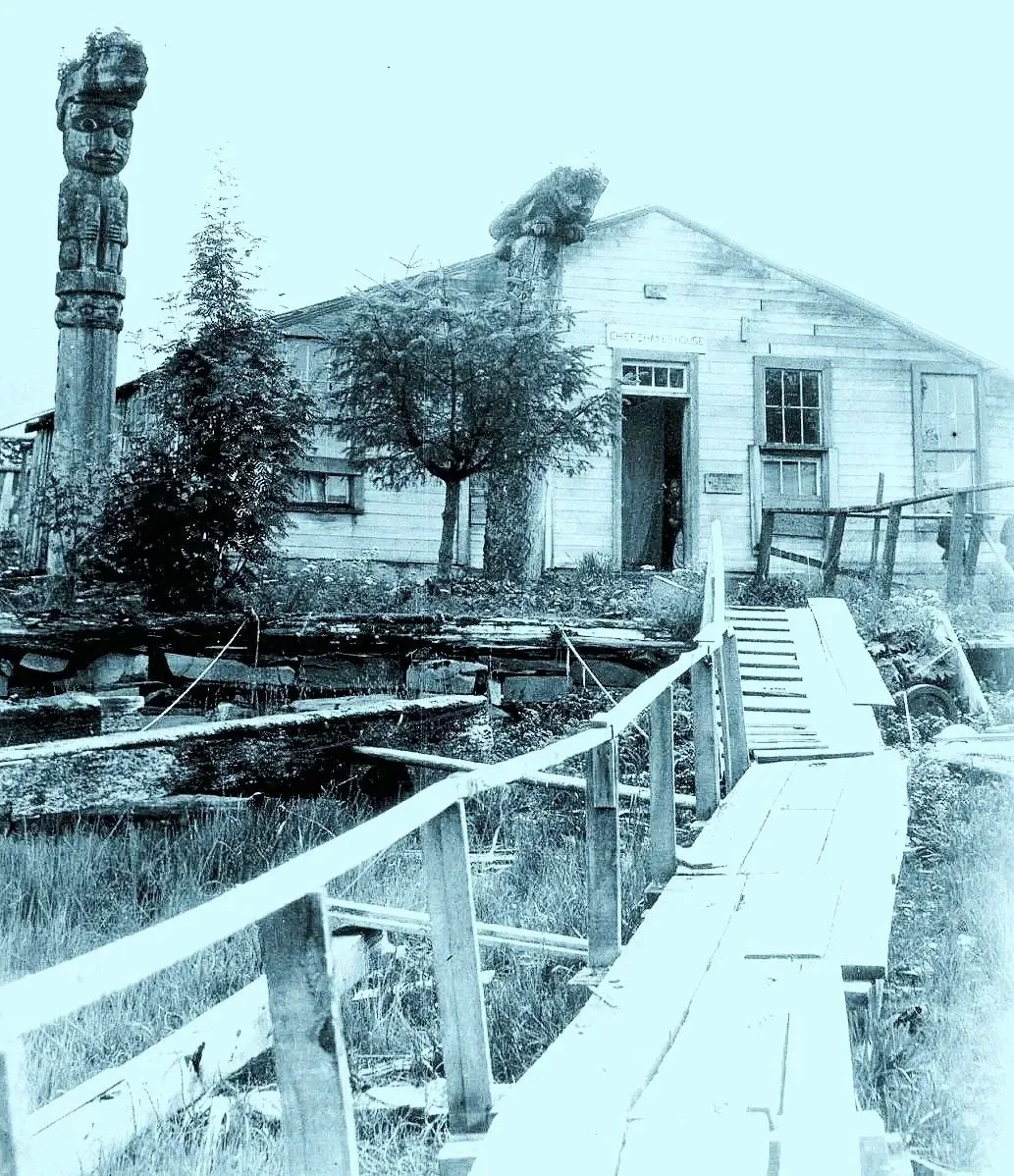
Shakes Island, date unknown.
At the end of 1934, Axel Rasmussen arranged with Mary Shakes to purchase her share of Shakes Island. He agreed to pay Mary Shakes $5 a week for 200 weeks, for a total of $1,000. The deal included the clan house, totem poles, and the Moses Shakes monument.
Around this year, Axel Rasmussen began operating a museum out of the clan house on Shakes Island. Visitors could see an authentic Tlingit-style clan house, along with items from Rasmussen’s expansive collection of Indigenous artifacts. The February 23, 1934 Wrangell Sentinel described how Rasmussen ushered a group of visiting Sheldon Jackson school students around the Wrangell school building “and also showed them his museum.” When a submarine visited Wrangell in July 1934, the officers aboard spent “a half hour with Supt. Rasmussen in the museum before assembling in the hall” which was decorated with “ceremonial robes, Chilkat blankets and beaded bags from the Rasmussen collection of Indian curios,” according to the July 27, 1934 Wrangell Sentinel. The July 17, 1936 Wrangell Sentinel described how visitors from the American Home Economics Association visited Wrangell, and “those who were interested were taken to the Shakes communal house where they heard the lecture given by Axel Rasmussen for which they expressed great appreciation.” Later on, Rasmussen would report that he typically made about $400 each summer operating the museum.
A photograph of the Wrangell public schools faculty, with Rasmussen standing center in the back, from 1935. (image credit: Wrangell Museum 1999.011.030)
School Board Controversy
After a decade in Wrangell, Axel Rasmussen had endeared himself to the town and the student body. He was known for giving speeches that motivating students to do their best. He was optimistic, energetic, and well-liked. The May 4, 1934 Wrangell Sentinel published a letter from Valborg Brunsvold, who shared a humorous anecdote about Axel Rasmussen interrupting students practicing for a musical in front of the school. Brunsvold wrote:
“...the chief (under whose window we have no doubt practiced too long) literally bounced out of the building and burst forth in a lyric soprano 1 and 2 and 3, 1 and 2 and 3, 1 and 2 step step, left right—accompanied by frantic contortions of the feet, which looked surprisingly much like the dance steps which I had been demonstrating? And he was really good, too.”
So it came as a surprise in March 1936 when Axel Rasmussen’s contract was not renewed for another year. By a 2-1 vote, Wrangell’s School Board chose not to keep Rasmussen another year. The March 20, 1936 Wrangell Sentinel described how Rasmussen broke the news to his students:
“To quiet the many rumors that were flying about the town, Mr. Rasmussen addressed the assembly Thursday afternoon for less than two minutes. He told the students that he could not honestly say that he had resigned, as the fact was that a majority vote of the school board had decided against him. He stated that he and his foster son, Dick, would not be with them next year; that he was sorry and hoped that the remainder of the school year would continue to be pleasant.”
The students were outraged and quickly rallied to his side. They circulated a petition signed by a broad coalition of students, parents, and Wrangell’s leaders in business, civic, and Native affairs.
A headline from the March 20, 1936 Wrangell Sentinel reads, “High School Strong For Supt. Rasmussen.”
Everyone struggled to understand why Axel Rasmussen was being dismissed. In a letter to the Wrangell Sentinel, the high school students wondered, “Some people say Mr. Rasmussen doesn’t mix enough, but do we want a superintendent that smokes and drinks and gambles? He is setting a very good example for his pupils and they are all for him 100 per cent because he treats them all with the same squareness.”
Axel Rasmussen found a strong ally in the form of Louis Paul, a leader in the Alaska Native Brotherhood who fought for Alaska Native civil rights alongside his brother, William Paul. In a letter published by the Wrangell Sentinel, Louis went through the alleged reasons Rasmussen was let go:
“He does not shave enough. He lives outside the corporate limits of the town. He takes too much room in the school house for his curio collection. He burns too much light in the school house at night. He adopted an Indian boy.”
Point by point, Louis Paul refuted each charge as insignificant when compared to Rasmussen’s achievements. Under pressure, the key critic against Axel Rasmussen declined to run for re-election and was replaced. When the new school board met in April 1936, Axel Rasmussen was once again extended the role of superintendent for another year.
Despite the momentary setback, 1936 was one of Rasmussen’s most active years of collecting, where he added at least 53 items to his collection. Over one third of the new items came from Henry Moses, a German immigrant who set up shop in Sitka and traded throughout Alaska. Henry Moses and Axel Rasmussen would trade on at least four occasions.
National columnist Ernie Pyle wrote about Wrangell’s 1937 high school graduation. (image credit: Wikipeia Commons)
Moving On
Axel Rasmussen announced that the 1936-1937 school year would be his last in Wrangell. Rasmussen announced that he would move to Skagway in the fall to take over as Superintendent of Schools.
At the Wrangell High School graduation ceremony in June 1937, each graduating student gave a speech. Richard Johnson’s speech was on “Wrangell Youth and Leisure.” The ceremony was attended by nationally-renowned columnist Ernie Pyle. Pyle’s account of the graduation ceremony appeared in the June 23, 1937 Evansville Press:
“The five graduates sat bashfully on the stage among the speakers and school board members. Four boys and a girl. One of the boys was a fine-looking half-breed. Superintendent Axel Rasmussen has adopted him… Superintendent Rasmussen’s talk was brief and human. He said it was his graduation, too. He is stepping out after 11 years. He didn’t paint any glowing picture for the graduates, but he took them one at a time and touched on their good points and on some of their bad points, too, and said he wasn’t ashamed of a one of them.
After the ceremonies we went up and met Mr. Rasmusson… Rasmussen has become the vicinity’s greatest authority on Wrangell and Indian history. He has bought the old home of Chief Shakes, the last of the Thlingit Indian chiefs. In 11 years his roots have gone so deeply into Alaska that he intends to stay on here, even though he isn’t school superintendent anymore.”
As bittersweet as the farewell may have been, Rasmussen knew it was not forever.
Earlier that same year, Mary Shakes passed away. Rasmussen had faithfully paid $5 every week for her share of Shakes Island. With Mary Shakes gone, there was nobody to stand between him and owning Shakes Island. He envisioned a restored Shakes Island with a grand museum to display his world-class collection of artifacts. Shakes Island would be his summertime sanctuary away from Skagway, and the world would beat a path to his door.
But Axel Rasmussen would be challenged. Shakes Island was not an artifact. Shakes Island was a landmark, and Wrangell was willing to fight for it.