

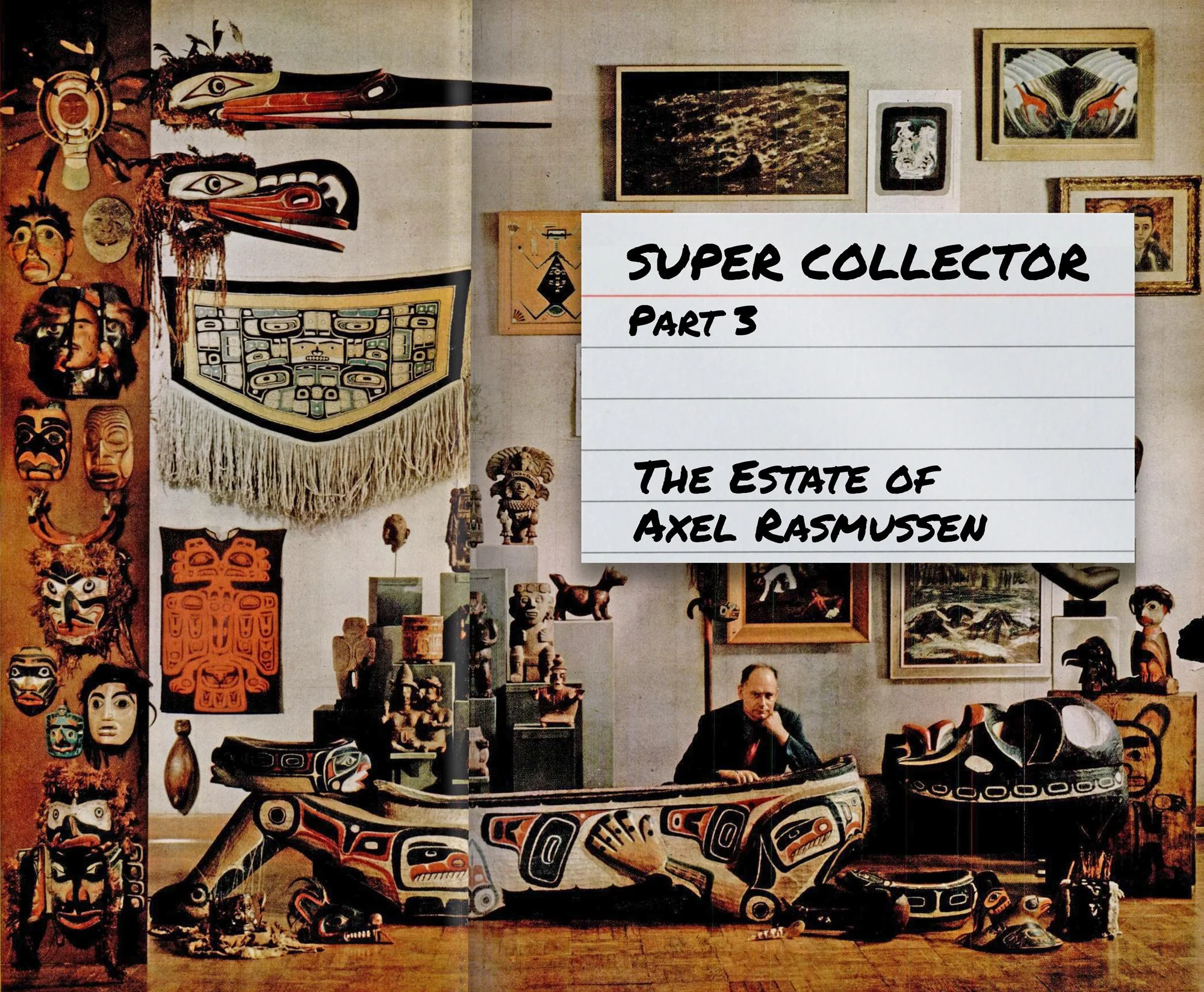
Just as quietly as Axel Rasmussen amassed his collection, so too was it sold and shipped out of Alaska, where most of it resides in the Portland Art Museum today. His legacy is the collection he built and the hole it left when it went away.
BY RONAN ROONEY • WRANGELL HISTORY UNLOCKED
PUBLISHED THURSDAY, JUNE 18, 2026
(IMAGE CREDIT: LIFE MAGAZINE, JULY 31, 1950)
← Super Collector, Part 1: Axel Rasmussen Goes to Alaska
← Super Collector, Part 2: The Fight for Shakes Island
The bombing of Pearl Harbor on December 7, 1941.
War Comes to Alaska
After moving to Skagway in 1937, Axel Rasmussen found new trading partners from the upper reaches of southeast Alaska. His collection and reputation grew. He was even considered for the position of Curator of the Alaska Museum, but the job went to Wrangell Institute Arts & Crafts teacher E.L. Keithahn.
As he had since 1926, Axel Rasmussen continued working as a school superintendent. In Lost Heritage of Alaska, former school teacher Elizabeth Selmer described Rasmussen as:
“He was a quiet, rather lonely man absorbed in three things—a strong interest in the church, a great love for children… and a desire to gather and save the art of the Alaskan Indian.”
Axel Rasmussen never married and had no children. His only family in Alaska was Ned Johnson, who he came to know after adopting Ned’s brother, Richard Johnson. Tragically, Richard drowned in 1939. Ned Johnson and Axel Rasmussen continued to remain close. During the school year, Ned attended high school at the Sheldon Jackson boarding school in Sitka, but he spent his summers with Axel Rasmussen in Wrangell.
In late spring 1941, Ned Johnson graduated high school. For a young man who spent many years inside institutions, he was finally free to start his own life. But the bombing of Pearl Harbor on December 7, 1941 would change everything. Whatever future plans he had were put on hold. In July 1942, the month after his 20th birthday, Ned Johnson enlisted in the U.S. Army and listed Axel Rasmussen has his permanent contact.
The war would change Skagway, too. Skagway became a critical hub in connecting Alaska to the United States. One of the relics of Skagway’s goldrush past was a train route that ran into Canada, to the town of Whitehorse. According to the documentary Skagway at War,
“If construction materials were brought north by sea to Skagway, the White Pass and Yukon Railroad could get them to Whitehorse, and from Whitehorse crews could build both north and south. Using Skagway, highway construction time would be cut in half.”
Virtually overnight, thousands of American forces arrived in Skagway to begin work on the highway.
Left: Reverend Harold F. Fredsell. (image credit: Detroit Times, January 25, 1952) Right: Edward Rasmuson in 1905. (image source: Alaska State Library)
Called to Service
With Ned Johnson away at war, Axel Rasmussen lived alone in Skagway. He continued to build his collection which he displayed in Skagway at a self-styled museum. There are no public records of Rasmussen collecting any items in 1942, perhaps due to changes brought by the war, but that year he loaned a “male Tlingit skeleton from near Wrangell” to the Smithsonian Museum. In 1943, Rasmussen acquired at least 28 items — all but three from his old trading partner, George Thornton Emmons. Emmons was over ninety years old and may have been interested in entrusting his collection to someone who could carry on his legacy. In the end, Emmons would outlive Rasmussen.
Rasmussen came to know Skagway’s Presbyterian minister, Reverend Harold F. Fredsell. Reverend Fredsell arrived in Skagway in 1944 and was tasked with not only ministering to Skagway’s local congregation, but also the spiritual needs of hundreds of men serving in the Army. They required not only pastoral care, but also services that connected them to traditions back home. For support, Reverend Fredsell called upon Axel Rasmussen’s prior life as a Presbyterian minister for help.
Reverend Fredsell also turned to another former Presbyterian minister in Skagway with a similar-sounding name. Edward Rasmuson and Axel Rasmussen were two completely different men, yet their identical-sounding names created confusion in the past as in today. They were both close in age, born in the 1880s. Both of their mothers were from Sweden. While Edward Rasmuson came to Alaska in 1904 as a teacher and took on Presbyterian missionary work, Axel Rasmussen came to Alaska in 1926 to work in schools after a previous life as a Presbyterian minister. They both built their reputations and success in southeast Alaska: Edward for his banks and Axel for his artifacts.
In 1944, Edward Rasmuson turned over control of the Bank of Alaska to his son, Elmer Rasmuson. Freed up to help the war effort, Edward Rasmuson joined Axel Rasmusson in running services for the local Presbyterian church. On November 15, 1944, Reverend Fredsell wrote to his superior:
“Communion was observed on November 5th at the morning service, the first time this year. Fifty three participated in the Lord’s Supper. Elders E.A. Rasmuson and Axel Rasmussen, served assisted by two fine young service men...”
Axel Rasmussen’s health continued to decline. On December 18, 1944, Rasmussen was admitted to Swedish Hospital in Seattle, Washington. For the Christmas Eve church service, Reverend Fredsell made a note to the congregation, “During this Christmas session Elder Axel Rasmussen is in a Seattle hospital. We wish him Godspeed and hope he returns soon.”
But Axel Rasmussen would never make it back to Alaska.
The Death of Axel Rasmussen
Axel Rasmussen died of cancer at the age of 58 on January 3, 1945 in Seattle, Washington. Before he died, he sent for Ned Johnson, but it was too late.
There were few mentions of Axel Rasmussen’s death in the media. Two days after he died, the Alaska Empire described Rasmussen as a collector and “recognized authority on the subject” of Tlingit culture. A week later, the Wrangell Sentinel announced Rasmussen’s death, adding that “his hobby was collecting and he had one of the finest private collections of Indian art in Alaska.” The Journal and Courier of Indiana reported that Rasmussen’s body would be returned to his brother’s home in Oxford before burial. There was no local newspaper in Skagway to report on Rasmussen’s death, contributing to the limited coverage of his passing.
Reverend Fredsell wrote to his superior, “You will notice word of the death of Axel Rasmussen, one of our finest officers and a fine Superintendent of Schools. His loss is great to the church and the community.” Fredsell reported that the Skagway Presbyterian church planned to establish a memorial in Rasmussen’s honor.
As those who knew him mourned, they also wondered what would become of his collection. With no widow or biological children of his own, Reverend Fredsell speculated if Ned Johnson might inherit the entire estate.
A Navy PBY plane used in World War II. (image credit: Horace Bristol)
Crash Boats & Rescue Missions
Ned Johnson spent World War II manning crash boats, named for coming to the rescue of aircraft that crashed into the sea. He rescued men from drowning in the cold, dark Alaskan waters. It was fitting work for Ned whose brother, Richard, had drowned in Alaska only a few years earlier. In later years, the Wrangell Sentinel reported:
“[Ned Johnson] remembers one rescue operation when a Navy PBY went down. The plane was found drifting and taking on water, the crew huddled together on the wings. Their crash boat towed the plane until met by a larger Navy ship that was able to lift the plane free of the water.”
As Ned described it, “They were so seasick and glad to see us.” In 1943, he wrote a letter to the Wrangell Sentinel on behalf of his fellow Wrangell service members stationed together “somewhere on the Alaska front.” He wrote they all missed Wrangell and were eager for letters home, adding, “There aren’t any dames or trees hanging around. I sure miss them both.”
Axel Rasmussen died at the beginning of 1945 before Ned Johnson could get to him. By the time Ned Johnson arrived in Skagway, it was February 1945, and Rasmussen’s remains had already been sent to Indiana. Reverend Fredsell planned a dinner for Ned Johnson. In a letter to his superior, Reverend Fredsell wrote:
“I am having dinner for Ned Johnson tomorrow night an Indian boy who was adopted by Mr. Rasmussen. Ned is a product of Haines House and Sheldon Jackson School. At present he is in the Army and whether he is legally adopted is not certain. The two brothers of our former Elder and his sister reside at Oxford, Indiana and are members of the Presbyterian Church.”
Reverend Fredsell described Rasmussen’s collection as the “finest, most extensive and costly collection in the Whole of Alaska” valued around $20,000 to $30,000. But there were practical concerns, as well. Finding a place to store this massive collection would be challenging. Reverend Fredsell wrote:
“There is considerable conjecture as to what will happen to this collection. It will be difficult for the heirs to find a ready market for it. Some of the townspeople would like to keep it in Skagway, but it would need a caretaker and a fire-proof building. I wonder if we could possibly handle it at the Sheldon Jackson School? Perhaps we could find someone who would be interested in purchasing it for the school if it is placed up for sale.”
That month, a judge authorized Skagway school teacher Walter Savikko to serve as executor of Rasmussen’s estate, but when Savikko soon bowed out, Reverend Fredsell assumed the role of executor of Axel Rasmussen’s estate. With the war still in full throttle, Ned Johnson returned to service for the rest of the war. The matters of Axel Rasmussen’s estate would be decided by other people.
Sizing Up the Estate
Read the Original Probate Court Record for Axel Rasmussen
As executor of Rasmussen’s estate, Reverend Fredsell’s responsibilities were twofold. First, he would be responsible determining the value of all of Rasmussen’s possessions. Second, he would oversee the sale of any items from Rasmussen’s sizable estate.
He identified Rasmussen-owned property in Skagway, Wrangell, Indiana, and the Denver Art Museum. At each location, Fredsell contacted groups who could itemize and estimate the value of each piece of Rasmussen’s estate. At no point does Reverend Fredsell seem to have consulted with any Alaska Native individuals to discuss the financial, spiritual, or cultural the value of items in the Rasmussen’s collection.
According to the probate records, Rasmussen’s property included:
WRANGELL: A total of $2,550, including $400 worth of curios stored at the Wrangell Institute and $500 worth of curios in a boat house. This included Rasmussen’s house, boathouse, boat, and title to the property.
SKAGWAY: A total of $7,905, including $5,000 for the “Collection of Indian Curios, known as Skagway North West Indian Museum.”
DENVER ART MUSEUM: A total of $1,240.50 for 51 items owned by Axel Rasmussen on loan to the museum, ranging from $1 to $100.
GRAND TOTAL: $11,695.50.
In order to save on the cost of publication, the judge ruled that the court would not publish any notices of Rasmussen’s estate in newspapers. The judge made the decision in part because Skagway had no local newspaper. Instead, the only official notices about Rasmussen’s estate were posted in Skagway at the post office, courthouse, and community bulletin board. This failure to post notices in newspapers added to a general lack of awareness about Rasmussen’s death or the pending dispersement of his estate.
Heirs to the Estate
Axel Rasmussen died without a will, leaving his estate in the hands of an executor to determine who his next of kin was. In early 1945, Reverend Fredsell was initially under the impression that Rasmussen had adopted Ned Johnson. But a modern-day investigation of Alaska’s adoption records reveals what Reverend Fredsell likely discovered in 1945: there is no paperwork suggesting Axel Rasmussen legally adopted Richard or Ned Johnson.
On these grounds, Reverend Fredsell awarded the estate to Axel Rasmussen’s siblings: Henry, Edward, and Jennie, along with his late brother David’s son and daughter. To these five blood relatives of Axel Rasmussen, Reverend Fredsell awarded the estate of Axel Rasmussen. When all property was sold and all debts settled, each sibling would receive one-quarter of the value of Rasmussen’s estate, and David’s children would each share one-eighth of the estate.
There may always be questions about why Ned Johnson did not inherit Axel Rasmussen’s estate. If he had, he would have come into a fortune immediately after leaving the Army. But Ned Johnson was called to service during the time that Reverend Fredsell handled the estate. If there was a case to be made, Ned Johnson was at a severe disadvantage to make it.
It’s not clear that any of Rasmussen’s siblings ever met Ned Johnson. They may have remembered Richard Johnson who visited Indiana in 1933. While Ned Johnson was not legally adopted, everyone understood the importance of Richard and Ned Johnson to Axel Rasmussen. Because of this, Rasmussen’s siblings agreed to give Ned Johnson all of Rasmussen’s Wrangell property, house, boathouse, boat, tools, cabinets, and more. Each of the siblings took a cut of their inheritance to compensate their niece and nephew for the cost of the gift. No Indigenous artifacts from Rasmussen’s collection were included in this gift. In the end, Ned Johnson received $1,300 in real estate, $150 in household goods, and $125 for motor, tools, and cabinets, for a total of $1,575.
In a filing with the court at the end of 1945, Reverend Fredsell explained the reason for the gift:
“The former home of the deceased and personal property in the amount appraised at $275.00 be set aside and given to a native boy, Edward Johnson, as that boy, though not formally legally adopted had been so adopted by the deceased and would undoubtedly been named as one of the heirs had the deceased mad a will, the deceased having among other things instructed the bank where the deceased did his banking, to honor checks against his account, signed by said Edward Johnson, in the same manner as the bank did honor his own checks, also, before his death he wired him to come to his death bed…”
The timing of the gift was fortunate for Ned Johnson. In September 1945, Japan surrendered. The war was over. Two months later, Ned Johnson was honorably discharged. He returned to Wrangell, a place he knew through his brother Richard and Axel Rasmussen. Now, both of them were dead, and he was left alone in Rasmussen’s home, which was now his home. For a young man who had spent most of his life between boarding schools and barracks, Ned Johnson finally had a place to call his own.
But that Christmas, he had no family to call his own. Ned Johnson took the opportunity given to him and began building his future.
The cover of “Exhibitionist: Earl Stendahl, Art Dealer as Impresario” by April Dammann.
Earl Stendahl
The sale and distribution of Axel Rasmussen’s collection of Indigenous artifacts would be masterminded by one man: Earl Stendahl.
Earl Stendahl was a flashy, ambitious art collector from Los Angeles, California. He made his reputation before and during the Great Depression by hosting gallery exhibitions of paintings around Los Angeles and Hollywood. He had a flare for promotion and identifying the next big thing. He attracted movie stars who consulted him about which pieces of art to add to their collections. He was an expert witness in a lawsuit brought by a film actress who sued a painter for an unflattering portrait of her. Hollywood actor Vincent Price described Stendahl in his autobiography:
“…I’d met one of the greatest characters in the art world and one of the most controversially exciting—Earl Stendahl. No one has put Earl into his proper place in the history of great dealers, but I must say briefly that without them, we would know much less of the tremendous variety and brilliance of the art of Mexico, before Columbus.”
Having mastered the world of paintings, Earl Stendahl looked for something unique to attract people to his galleries. He looked south of the border. On September 25, 1938, the Los Angeles Times reported,
“Earl Stendahl is getting much pre-Columbian sculpture, beads, clay whistles and what-not from Mexico. Collectors find some important pieces among them. They make an interesting case at his gallery now. One clay cup was, he says, used for human blood.”
To fill his galleries, Stendahl mined Mexico’s “pre-Columbian” art for treasures. By May 5, 1940, the Los Angeles Times described him as “one of the country’s leading dealers in this field.” In June 1941, the Los Angeles Evening Citizen News reported that he shipped a four-foot statue “made in Mexico by an unknown Mexican Indian” to display in Los Angeles. The next year, the Pasadena Star-News reported that the Earl Stendahl Galleries in Los Angeles would display clay and stone figures from ten Central American cultures. Audiences were dazzled. Golden idols, masks, and figurines fascinated his audience of gallery goers in Hollywood and Los Angeles. The exhibit was a success and Stendahl became recognized as a leading expert in the field.
In some ways, Earl Stendahl was an archetype for the character of Indiana Jones. There were comparisons to be made, and not just the wide-brimmed hat. They both traveled deep into Indigenous country to secure ancestral cultural artifacts for the benefit of curious Westerners. Indiana Jones’ creedo, “it belongs in a museum,” typifies the philosophy guiding collectors like Earl Stendahl, who believed artifacts were better served on display by institutions.
In July 1945, after decades in the gallery business, Earl Stendahl abruptly announced his retirement. The July 22, 1945 Pasadena Star-News quoted him saying, “Six months rest is for sure, a trip to Alaska is probable and then he doesn’t know but says whatever he does ‘it will be interesting.’”
But this was a cover story. In fact, Earl Stendahl was far from retiring. He was just beginning his next venture, where he would copy his playbook from Mexico in Alaska. On September 17, 1945, the Daily Alaska Empire reported that “Earl L. Stendahl, of Hollywood, California, is a guest at the Baranof Hotel.” His intentions were not publicly clear, but on October 2, 1945, Earl Stendahl and Reverend Fredsell were passengers aboard the Princess Louise bound for Skagway.
According to his biographer, April Dammann, in Exhibitionist: Earl Stendahl, Art Dealer as Impresario:
“In tiny Skagway, a Klondike River Gold Rush town, he was shown the Axel Rasmussen collection: an extraordinary group of Native American artifacts, displayed in a nineteenth-century wood building described as ‘a wind tunnel.’ One good fire could rapidly wipe out everything.”
In Native Arts of the Pacific Northwest, author Robert Tyler Davis quotes Earl Stendahl describing his trip to Alaska:
“As our plane nosed up from the end of the icy Juneau airport the first leg of the hunt began. It took many days of shuttling before I found a man whose information led me to Skagway. Here was my cache!—the old Skagway Museum, closed for over a year. A brief inspection revealed a wealth of magnificent material.
The search for the executor, a Presbyterian minister, led me to Wrangell where still more of the collection was housed. Here started negotiations which lasted weeks, during which time I returned to the States and sought out two other segments of the material that had been sent to Indiana and Denver.”
After only three days in Skagway, Stendahl left to return to California. Seeing the collection was confirmation enough for Stendahl. At the same time the United States was celebrating Japan’s surrender in World War II, Earl Stendahl celebrated his latest purchase.
Earl Stendahl was the solution to Reverend Fredsell’s problem. In his report to the probate court, Reverend Fredsell declared “your administrator has an offer of $12,500.00 for the remained of the collections at Skagway, Wrangell, and Denver.”
On December 28, 1945, Earl Stendahl was back in the Baranof Hotel in Juneau. He had avoided media attention in Alaska, but the Los Angeles Times had the story in its December 30, 1945 issue:
“EYES NORTH - Earl Stendahl, indefatigable impresario of art indigenous to this content, recently flew to Alaska to purchase a collection of 8500 art objects made by Indians and Eskimos of the Northwest coast and islands. This is reputed to be the most important group of its kind still in private hands. Part of the collection is in Alaska, other parts are in United States museums. There are tentative plans to show it at Los Angeles County Museum next year.”
According to his biographer April Dammann, “Over the course of several weeks, Stendahl single-handedly packed up twenty-five crates to ship south for his exhibit at the Los Angeles County Museum of History, Science, and Art.” In Native Arts of the Pacific Northwest, Stendahl is quoted as saying,
“January found me again in Skagway foraging for packing materials and forced to crate singlehandedly the entire collection. It was a two-week job carried on in a veritable deep freeze unit with only a small oilstove for company.”
The failure of the court to publish notices about his estate, and the scarcity of newspaper reports about Rasmussen’s death, have shrouded these events in secrecy. By the time Alaskan newspapers picked up on the story, the collection was already gone. The January 15, 1946 Daily Alaska Empire wrote:
“Earl Stendahl of Los Angeles, Calif., who purchased the Rasmussen museum, was in Skagway for several days packing the collection, said to be one of the finest Alaskan collections in the Territory. Mr. Stendahl plans to exhibit the collection in Los Angeles for two or three months, then sell it intact to some larger museum. Mr. Stendahl has traveled through Central American and Mexico, San Salvador, Honduras, etc., seeking exhibits of early civilization. He left by plane Friday for Juneau, where he caught another plane for Seattle.”
In September 1946, Earl Stendahl added to his sterling reputation in California by staging an exhibit of Rasmussen’s former collection. Newspapers and visitors raved about the unique artwork of the Indigenous peoples of the Pacific Northwest. The February 16, 1947 San Francisco Chronicle described it as, “The incredible fantasy, the rich symbolism, the dark, fatalistic feeling of indigenous Northwest art has never been more magnificently displayed in my experience of such things.”
The September 29, 1946 Pasadena Star-News:
“The Stendahl collection, filling three galleries downstairs, is sponsored by the history department but it is filled with art. The sensibility and sometimes lack of sensibility in these northwest Indian and Eskimos is clearly felt in the humor, imagination, fear and power transmitted in the carving of masks, weapons, clothes, cooking utensils, food, and fishing equipment.”
The capstone of Axel Rasmussen’s estate was the sale of his thousands of Indigenous artifacts. Most of the value of Rasmussen’s estate was in these artifacts, which numbered into the thousands and contained unique, one-of-a-kind examples of Pacific Northwest Indigenous coastal art. Earl Stendahl received glowing reviews for the Rasmussen collection, but he was not the only one with artifacts from Axel Rasmussen’s collection.
Wrangell Institute Sells Items
Axel Rasmussen left behind many items at the Wrangell Institute. It may have been an act of generosity, aimed at helping students in E.L. Keithahn’s Indian Arts & Crafts program, where students learned traditional carving methods. It may have been simply because Rasmussen had nowhere else to store his copious collection of artifacts. Upon his death, the estate appraisers estimated the value of his artifacts in Wrangell at $400.
On October 2, 1945, shortly before Earl Stendahl and Reverend Fredsell left Juneau for Skagway, two men arrived aboard a steamship from Wrangell: Wrangell Institute principal Earl Intolubbe and staff member Henry Barrow.
Henry Barrow and his wife, Susan, worked at the Wrangell Institute and were interested in buying the artifacts. There were roughly 150 items, including tools, ornaments, baskets, and other unique pieces of handcrafted Indigenous art. They were both non-Native, but Susan had studied Indigenous cultures at the University of Washington and was reportedly a proficient weaver. With little fanfare, the Barrows acquired Rasmussen’s artifacts from the Wrangell Institute.
Shortly after purchasing these items, the Barrows left Wrangell. Within a few years, the Barrows provided the items to the Smithsonian Museum, where they reside today.
The Beaver Totem Pole in 1898 (left) and at the Alaska State Museum in Juneau (right). (image credit: Wikipedia Commons)
the Alaska Museum Buys Items
In 1941, Axel Rasmussen narrowly lost out on the job of Curator at the Alaska Museum in Juneau to E.L. Keithahn. Keithahn, having taught Arts & Crafts at the Wrangell Institute, was intimately familiar with Rasmussen and his collection.
While in Juneau in late 1945, Earl Stendahl and Reverend Fredsell likely met with E.L. Keithahn. Despite his desire to keep as much in Alaska as possible, only a small selection of items were sent to the Alaska Museum. A 1946 report from Alaska’s governor stated,
“Purchased from the Axel Rasmussen collection were 68 items of great ethnological importance. Among them were the Wrangell ‘Beaver’ totem pole in 3 sections, a replica of the ‘Rain Wall’ from the Whale House at Klukwan, soapberry spoons, a Haida argillite flute and platter of great beauty, four Chilkat blanket pattern boards, a crayon portrait of Chief Shakes V made about 1834.”
For years to come, people would lament that Alaska was unable to keep all the items from the Rasmussen collection. It may have been due to a combination of expense, lack of fire-proof storage facilities, and lack of awareness. The Daily Alaska Empire on April 7, 1947 wrote, “The sale of this collection of more than 800 items representing Indian and Eskimo creative work, ceremonial masks, wood carving and paintings and other interesting articles was a definitely loss not only to Skagway but the Territory.” Art critic Katharine Kuh visited Alaska shortly after the sale and complained bitterly,
“The waste of cultural natural resources in Southeastern Alaska is evident in rotting totem poles not only on distant deserted islands, but also within well-populated city limits such as Ketchikan’s Ball Park. Typical of this same waste is the recent sale last season of the local Rasmussen collection to a California art dealer, thus depriving the Territory of one of the finest collections of North Pacific art in existence…”
(To find collection items on the Alaska State Library website, search the word “Rasmussen.”)
Portland Art Museum
For the Portland Art Museum, the decision to host an exhibition of Stendahl’s Northwest Coast artifacts was an obvious choice.
For two months in 1944, the museum hosted an exhibit entitled Art of the Pacific Coast Indians. The Sunday Oregonian of February 6, 1944 called it “one of the most important exhibitions of the year.” The exhibit proved popular with audiences, especially children, and was extended for two weeks. Museum curator Robert Tyler Davis wrote to the Oregon Daily Journal:
“It also happens that our current exhibit of Northwest Indian art contains much that would be very interesting to children. The word ‘Indian’ itself has an appeal for children, and the characteristic animal designs in much of their work could not fail to fascinate them.”
When the opportunity arose to display Axel Rasmussen’s former collection, the Portland Art Museum leapt at the chance. In 1947, the museum and Stendahl negotiated an arrangement to temporarily display the Rasmussen items. The exhibition was a hit. The Sunday Oregonian of April 27, 1947 wrote:
“Most important showing is the magnificent collection of Indian art of the northwest coast, which may be viewed through June 1… The collection is unique among private collections in many respects; in size, quality, and in educational intent. It was assembled over a period of years by Axel Rasmussen, superintendent of schools in Skagway, Alaska. After his death the entire collection passed into the hands of Earl Stendahl, California art dealer, through whose courtesy it is being shown here...
The public spirited person or firm who saw fit to acquire this collection for the museum would be remembered gratefully by generations of the city’s art students, industrial designers, and school children. Such a gift would be a real and lasting contribution to the city’s cultural assets.”
The Rasmussen collection at the Portland Art Museum proved so popular that the museum made a bid to purchase all the items. Under the headline, “Want to Know a Secret? Art Museum Has Indian Treasure in Basement,” The October 17, 1948 Oregon Daily Journal wrote:
“Following the exhibition the museum took an option to purchase the whole collection. It hasn’t yet found the money to pay for it. The purchase price is $27,500, the worth of the collection is incalculable and, as Thomas C. Colt, Jr., the museum’s new director, says, ‘it belongs here.’ ”
Earl Stendahl paid the estate of Axel Rasmussen $12,500 for the entire Rasmussen collection of Indigenous artifacts. He sold many—but not all—of those items to the Portland Art Museum for $27,500, a difference of $15,000.
While the museum acquired the collection from Earl Stendahl, it was named for the man who originally built it: The Rasmussen Collection.
A photograph of Yeffe Kimball from the March 17, 1949 issue of The Oregonian.
Yeffee Kimball
To prepare the Rasmussen Collection for display, the Portland Art Museum hired a woman it believed was both a Native American and an expert in art: Yeffe Kimball.
Yeffe Kimball was born in 1906 to white parents in Missouri. She created an identity for herself as a Native American woman from Oklahoma. She wore her hair in two long, even braids down the front. By the age of 29, she attempted to pass herself as an Indian princess. Paul Harrison wrote that she “could pass for a princess, but never an Indian.”
She continued the ruse, and by the 1940s, she was selling her paintings alongside actual Indigenous women. The January 1, 1948 Tulsa World newspaper reported her fabricated story as:
“She is Yeffe Kimball, who was born in Mountain Park, Kiowa county, spent most of her years on her grandfather’s farm in Missouri, graduated from the University of Oklahoma and then embarked upon a career of study and painting which took her to Europe and to the many corners of the United States. Her Osage blood has prompted an extensive interest in her Indian heritage which is reflected in her paintings.”
At the beginning of 1949, the Portland Art Museum entrusted the care of the Rasmussen Collection to Yeffe Kimball. The Oregon Journal of March 17, 1949 wrote:
“Any day Yeffe can be found either at her table with hammers, pliers, paints and wires or sitting Indian fashion on the floor of the gallery carefully studying the many objects temporarily on the floor. To walk in upon her on the job for the first time is rather breathtaking. Her thick raven braids, tied together and flipped around her neck, swing down. A tiny foot, clothed in a mocassin, peeps from under a full suede skirt. She looks just like a very serious Indian girl.”
Newspapers ran photographs of Yeffe Kimball working among items in the collection and showing it to others. The April 17, 1949 Sunday Oregonian announced the exhibit would soon open, remarking, “the installation has required considerable time and the expert guidance of Miss Yeffe Kimball, nationally-recognized authority on Indian art, who has been consultant in the identifying and placement of the items.”
Oregon Daily Journal, January 8, 1950
Commercial and Critical Success
From the beginning and decades to come, the Axel Rasmussen Collection at the Portland Art Museum was a commercial and critical success. The Rasmussen collection redefined the Portland Art Museum and made it a major institution. In the landscape of American museums, nothing rivaled the quality, scale, and scope of Rasmussen’s prolific collection:
“Exhibitions come and go at the Portland Art museum but the current one of Northwest Indian textiles, from the museum’s vast Rasmussen collection, will be remembered as outstanding.” (Oregon Daily Journal, January 8, 1950)
“In the Rasmussen Art Museum one finds Eskimo art expressed with a quality of lightness and grace.” (Barre Daily Times, December 13, 1950)
“This is the show of the year.” (Montreal Star, March 17, 1951)
“An Alaskan school superintendent of the early 20th century grew interested in the remnants of a once-rich artistic life he found moldering in the countryside. For 25 years he salvaged ancient objects from decay. The result of his labor is the Axel Rasmussen collection which forms the backbone of the Portland Art museum’s northwest display.” (Star Tribune, December 14, 1952)
“The Portland Art Museum’s Axel Rasmussen collection of Northwest native arts, internationally known and admired, is only now beginning to be exploited by the design trade, although comparable collections in other regions have long been used for source material.” (The Sunday Oregonian, July 4, 1954)
“The Rasmussen collection at the Portland Art museum includes several fine examples of the North Coast Indians’ buttonwork—mainly on ceremonial clothing. (The Oregonian, July 12, 1954)
“Especially outstanding was the Rasmussen collection of Pacific Northwest Indian Art in the Portland Art Museum. A total of 5,000 valuable objects from Alaska and the Northwest coast are contained in this collection assembled by the late Axel Rasmussen and now owned by the museum.” (Lubbock Avalance Journal, August 21, 1955)
“The collection is one of the five best in the country and since it is considered countrywide an extremely valuable resource for both art and social studies, the museum feels its enjoyment and research possibilities should be more widely used in the community...” (The Sunday Oregonian, September 30, 1956)
“Permanent collections at the museum which are popular with out-of-town visitors are of course the Kress collection, the Rasmussen collection of Indian artifacts, the Greek vases and the Oriental collection.” (The Sunday Oregonian, August 25, 1957)
“In response to numerous requests from these students throughout the state, the Rasmussen exhibit of Northwest Indians will be viewed, with Junior League members serving as guides.” (The Oregonian, April 18, 1958)
“The Portland Art Museum’s nationally famous Rasmussen collection of Northwest Indian Art is again open to the public after being closed for an extensive period for redecoration and reinstallation.” (The Sunday Oregonian, April 19, 1959)
“There is much at the Portland Art museum to interest children as well as adults. The Rasmussen collection of Northwest Indian Art, the Pre-Columbian Art, the collection of small sculptures started just for children, and the scarab collection are favorites with youthful viewers…” (The Sunday Oregonian, July 17, 1960)
“Of special interest to visitors who have never had the opportunity of seeing it is the Rasmussen Collection of Northwest Indian art, a permanent installation in the Art Museum. One of the finest collections in the country, it has great appeal for children and adults.” (The Sunday Oregonian, June 4, 1961)
“The distinguished group of directors coming from major American and Canadian museums also will have the opportunity of seeing the museum’s nationally-known Rasmussen Collection of Northwest Indian Art.” (The Oregonian, May 20, 1963)
“Davis, for five years director of the Montreal Museum, was instrumental in bringing to Portland the new famous Rasmussen collection of Northwest Indian Art.” (The Oregon Daily Journal, June 1, 1963)
“The Women’s Committee of the Portland Art Association will have the Northwest Indian Gallery of the Portland Art Museum painted. This section houses the Rasmussen Collection, and is one of the most-visited parts of the museum.” (The Oregon Daily Journal, July 22, 1964)
“Portland is known for roses and rain, baby elephants, nearby rivers and mountains. But it is not so well known that we have an outstanding collection of Northwest Indian art, the Rasmussen Collection in the Portland Art Museum.” (The Sunday Oregonian, November 13, 1966)
“The Portland Art Museum is the proud owner of another fine collection. Most of the objects were gathered by the late Axel Rasmussen, a superintendent of schools in Alaska, between 1926 and the mid-forties.” (The Sunday Oregonian, November 24, 1968)
“…The Rasmussen Collection of Indian Art is almost certainly the single most memorable aspect of the museum’s holdings. Rasmussen, a teacher and later Superintendent of Schools in Skagway, Alaska, managed somehow, during the late 1920s and early 1930s, to bring together a vast assortment of tribal relics of the sort that had, even then, all but vanished as a result of the conflict between white and Indian cultures.” (The Post Crescent, October 31, 1971)
“If ever there was an exhibition filled with surprises, it would be that extravaganza of Arctic art that now holds sway through Nov. 18, at Portland Art Museum. To this viewer’s way of thinking, ‘Surprise No. 1’ about ‘2,000 Years of American Eskimo and Indian Art’ is that it establishes Alaska as a center of native art equal in beauty and inventiveness to any in the world.” (Oregon Journal, October 3, 1973)
Anthropologist Bill Holm: “The opening of the reinstalled Rasmussen Collection would be occasion enough for rejoicing among admirers of Northwest Coast art. The museum’s own collection is one of the best. The new installation is less open than the old, but consolidation of the collection may increase the sense of intimacy and richness of the setting and its treasures.” (The Sunday Oregonian, October 7, 1973)
Portland Chamber of Commerce President Oliver Larson: “We’ve hit the major leagues in art. One of the major art collections in the country — the Rasmussen collection of Alaskan Eskimo, Indian, and Aleut art — is here at the Portland Art Museum.” (The Oregonian, June 17, 1977)
“The Portland Art Museum’s Rasmussen Collection of more than 800 pieces was acquired in 1948 and remains one of the ranking collections of late 19th- and early 20th-century Indian art in the world. (The Sunday Oregonian, September 7, 1980)
“Gray, rainy days of winter are a good time to spend an hour examining the art of the North Coast Indians, as may be seen in the Rasmussen Collection of Northwest Indian Art in the Portland Art Museum…” (The Oregonian, March 10, 1989)
“The Portland Art Museum has been a longtime leader in this area, with its Rasmussen Collection of Northwest Coast Indian art and artifacts, a featured exhibit for 40 years…” (The Sunday Oregonian, June 11, 1989)
“But the main attraction here is the Rasmussen collection of Northwest Coastal Indian art and artifacts. There are excellent tribal masks and wood sculptures of mythical monsters who liked to dine out on humans. The pre-Columbian pieces, box drums, Potlatch dishes and canoes are all notable.” (Oakland Tribune, December 10, 1989)
“The Portland Art Museum made history in 1948 when it became one of the first fine arts museums int he country to include ethnographic art in its exhibits, acquiring the Axel Rasmussen Collection of Northwest Coast Indian Art. Included are masks, jewelry, boxes, totems and various ceremonial items from tribes that decorated everything in sight. This is a favorite of the 24,000 school children that visit the museum each year.” (The Oregonian, January 1, 1993)
Between the Rasmussen Collection of Northwest Coastal Indian art and the Elizabeth Cole Butler Collection — a pan-tribal archive part owned by and part on loan to the museum — the Portland Art Museum houses almost 3,000 Native American objects. The holdings are frequently counted among the top 10 such collections in the United States.” (The Sunday Oregonian, December 8, 1996)
“The wing’s centerpiece is the museum’s collections of Northwest art and American Indian art. Occupying three floors, the exhibits included prehistoric, historic and contemporary pieces from tribes across North America… A highlight is a 15-feet-long cedar wood feast dish from 1900, carved and painted to represent an important forest spirit.” (Tri City Herald, February 11, 2001)
In order to stimulate interest in the Rasmussen collection, newspapers often featured photographs of white women wearing regalia, such as hats, masks, and robes.
Beyond Portland
Rasmussen’s Collection did not just stay in Portland. Through arrangements with other institutions, many items from the exhibit traveled across the country for temporary exhibits in other universities and museums. The traveling exhibits exposed new audiences to a taste of Pacific Northwest Coast Indian art, while providing a source of revenue for the Portland Art Museum.
Another way the Portland Art Museum capitalized on the collection was to sell thousands of items. According to a current display at the Portland Art Museum, the museum acquired 2,959 items when it purchased the Rasmussen Collection 1948. Subsequently, the museum “sold or disposed” 2,123 items, leaving 827 at the Portland Art Museum. Finding the items that left Portland is an exhaustive task. Dozens are items are listed in the Beloit College Digital Collections. Fourteen items are listed in the Canadian Museum of History. Nearly two-hundred items sold by the Portland Art Museum to Doris Meltzer are now listed in the collections of Dartmouth University. There are certainly more institutions with Rasmussen collection items in their possession.
While institutions like this publicize the Indigenous artifacts in their collection, private collectors have no such requirement. During the time the artifacts were with Earl Stendahl, items may have been sold. In his autobiography, Vincent Price recalled turning down a “Northwest Coast Indian bowl” because it smelled strongly of whale fat. This frog carving from Anthropos Gallery suggests that Stendahl sold items in California, which stayed in California.
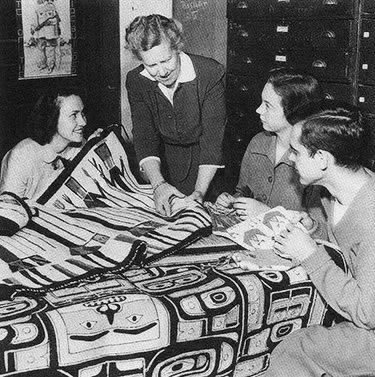
Erna Gunther (standing) surrounded by students. (image credit: University of Washington)
Erna Gunther
The Rasmussen Collection at the Portland Art Museum spawned several books. The first, Native Arts of the Pacific Northwest, was published by museum director Robert Tyler Davis shortly after acquiring the collection. It featured photographs of artifacts as well as details gleaned from Rasmussen’s notes. In 1952, former Portland Art Museum staffer Charlotte Baker published Sunrise Island, inspired by imagery and folklore of the Pacific Northwest coast and the items contained inside the Rasmussen Collection.
The most detailed published account of the Rasmussen Collection at the Portland Art Museum may have come in 1965, by University of Washington anthropologist Erna Gunther, who published Art in the Life of the Northwest Coast Indians. Gunther’s book offered more detail and analysis than Davis’ book, along with an index near the end of all the items in the Rasmussen Collection possessed by the Portland Art Museum in 1965. The book contains much information about the Rasmussen Collection not furnished by the Portland Art Museum online today.
Top Indigenous groups in the Rasmussen Collection at the Portland Art Museum in 1965 based on Gunther’s book. Excludes items not collected by Rasmussen. Tlingit 253, Unknown 41, Haida 38, Tsimshian 30, Kwakiutl 19, Salish 10, Nootka 7, and Other 9. (Excludes items not collected by Rasmussen).
Top Communities in the Rasmussen Collection at the Portland Art Museum in 1965 based on Gunther’s book. Excludes items not collected by Rasmussen. Unknown 144, Other 58, Klukwan 51, Wrangell 47, Yakutat 18, Queen Charlotte Islands 16, Huna (Hoonah) 14, Sitka 13, Angoon 9, Chilkat 8, Haines 8, Ketchikan 7, Alert Bay 5, Klawock 5, and Duncan 4. (Excludes items not collected by Rasmussen).
Repatriation
As with all resources in Alaska, the curio trade was a thriving industry, until the supply ran out.
Walter C. Waters died shortly before Axel Rasmussen. Like Rasmussen, he amassed a massive collection of Indigenous artifacts from Wrangell and the surrounding area. After hundreds of Waters’ artifacts were destroyed in Wrangell’s Great Fire of 1952, the remaining items were sold to the Denver Art Museum, where they reside today. In less than a decade, Wrangell lost two extraordinary collections of Indigenous artifacts numbering in the thousands. The loss changed Wrangell and Alaska forever. On the November 22, 1963, The Oregonian published a feature by writer Joan Davidson, who visited Wrangell and wrote:
“Of the many beautiful and important totem poles and artifacts that once were everywhere in and near Wrangell, dozens have been carried off (most of the pieces in the Portland Art Museum’s Rasmussen Collection are from Wrangell), dozens more have been buried, or chainsawed into firewood, to make way for the road.”
For Alaska’s Indigenous population, the loss was akin to cultural extinction. Generations of carvers, weavers, and craftsmen were deprived of the ability to study the works of the masters. Traditional ceremonies that depended upon sacred artifacts could not be performed with the artifacts under lock and key in a far-away museum. While museums often emphasized that these Indigenous artifacts were from a bygone cultures, Indigenous people never ceased to exist, and memories of the lost items persisted among those old enough to remember.
The U.S. civil rights movement of the 1960s-1970s included a revaluation of the Native Americans’ treatment by the federal government. Along with claims for land and equal treatment under the law, Native American groups petitioned for reunification with Indigenous artifacts. Native Americans contended they had been pushed to the margins of society, while their art had been displayed as a lucrative prize by institutions.
Within the Portland Art Museum, attitudes were changing, as well. In 1987, the museum hosted an exhibit of contemporary Native American art entitled “Lost and Found Traditions.” The same year, the museum received a $20,000 grant from the National Endowment for the Humanities to update the Rasmussen Collection display. The Oregonian of August 13, 1987 wrote, “Under the grant, the museum will undertake intensive research into design and display and will consult native elders to gain cultural perspective in the refurbished exhibit.”
In May 1989, the research culminated in what was called the“Rasmussen Planning Conference.” For three days, the Portland Art Museum hosted a gathering of Tlingit elders to view and offer insight on items in the Rasmussen Collection. According to the June 4, 1989 Oregonian,
“[David] Katzeek and the Tlingit elders are pleased to have been invited to consult with the art museum on the meaning of the artifacts. “There is a powerful message coming from these sessions. This is an awakening, saying to mankind, ‘There is more to life than dollars and cents. There is a balance to life.’ ”
In 1990, the United States Congress debated a bill which would required any museum receiving federal funding to implement a process where Native American groups could claim possession of sacred tribal artifacts and human remains. The bill would require investigating each piece of a collection for its historical and cultural value.
Dan Monroe, head of the Portland Art Museum, was skeptical of the bill. The February 25, 1990 Sunday Oregonian quoted him as saying, “The amount of money available wouldn’t even begin to pay for this research. It’s a touchy issue, and I think I really see both sides, but we at least have to begin with what’s possible.”
President George H.W. Bush signing NAGPRA into law on November 16, 1990.
In the end, Congress passed the bill. President George H.W. Bush signed NAGPRA (Native American Graves Protection and Repatriation Act) into law on November 16, 1990. While the new law opened the doors to repatriation, it required intensive work towards validating claims with evidence and research. In 1995, a NAGPRA conference was held in Sitka, Alaska to gather cultural knowledge. The process can take years, and cultural groups and institutions may find themselves at odds over interpretation of facts and the law. According to a display in the Portland Art Museum, of the thousands of Indigenous artifacts in the museum’s collection, only 28 have been repatriated.
In 2023, several items of clan at.óow were repatriated to Wrangell. KSTK News interviewed former Wrangell Cooperative Association president Xúns Richard Oliver, who said:
“It’s bringing back the culture and things that were forgotten... And in Wrangell, people need to learn how to carve. We don’t have any master carvers here. We have this cultural center, and we would like to get carving again, bring it back to Wrangell... We have a beautiful museum that really should be filled with the things that belong here.”
The cover of the July 1, 1999 Wrangell Sentinel featuring Ned Johnson and his wife, Karen.
A Place to To call Home
By the end of 1945, Ned Johnson was out of the Army and back in Wrangell, making his home in Axel Rasmussen’s former house. For a young man who had spent most of his life in orphanages, boarding schools, and barracks, he was finally free to live life on his own terms. He was 23 years old.
He found work as a carpenter, a skill he had learned in part from observing Axel Rasmussen. At the beginning of 1946, he met Karen Skulstad, a teenage girl who worked the counter at James Nolan’s Den O’ Sweets shop. The two had much in common. They both had ancestry in the Aleutian Islands through their mothers. They both saw World War II upend their lives. Karen was part of the Aleut Evacuation from her home, and Ned was part of the U.S. Army’s mission among the Aleutian Islands. The couple eventually married and had four children: Lorraine, Diane, Harley, and LaVonne.
In the 1950s, Ned founded Johnson Construction and became involved in many projects in Wrangell and the surrounding area. In 1971, according to the Wrangell Sentinel, Ned Johnson was “in charge of the renovation” of Shakes Island. He enjoyed not only large-scale projects, but small, fine crafts as well. After handing over control of the business to his son in 1993, the Wrangell Sentinel reported that Ned Johnson spent his retirement “in the workshop building and crafting everything from bird houses, furniture, whirly gigs, Christmas yard decorations, native paddles and other carvings.”
The Nolan Center and Wrangell Museum building in Wrangell, Alaska. (image credit: Alice Rooney)
Back in 1945, Reverend Fredsell lamented there was no fireproof museum in Alaska to store Rasmussen’s vast collection of Indigenous artifacts. As the twentieth century drew to a close, Wrangell would get its fireproof museum.
The Nolan Center was conceived as a multi-million dollar project paid for by the estate of James Nolan, Wrangell businessman and politician. The Rasmuson Foundation, operated by descendants of Edward Rasmuson, donated to the project, as well. The state-of-the-art facility could serve as a home for repatriated artifacts. The contract to build the new museum went to the company Ned founded, Johnson Construction. It was a full-circle moment.
Ned Johnson died in Wrangell on January 21, 2010 at the age of 87.
The author, Ronan Rooney, at the Portland Art Museum in 2026.
Shifting the narrative
In May 2026, I visited the Portland Art Museum to see if I could find anything from the Rasmussen exhibit. I walked up a flight up stairs and immediately found the Dzunk’ wa Feast Dish, created by Kwakwaka’wakw carver, Charlie James. It took my breath away. Throughout my research, it is one piece that was frequently photographed and often commented on. As far as I can tell, is it currently the only piece of the Rasmussen Collection on display at the Portland Art Museum.
Known locally as PAM, the museum is a foundational piece of Portland, a city that prides itself on progressive liberal values like cultural diversity and respect for Indigenous land acknowledgements. In the PAM gift shop, you’ll find hats that read “You Are On Native Land” and souvenirs featuring Indigenous artists — but nothing from the Rasmussen Collection.
According to a display in the museum by curator Kathleen Ash-Milby and assistant curator Erin Grant, the museum is “Shifting The Narrative:”
“Although the collection has long been recognized for its historical works from the Northwest Coast, Plains, and Western Oregon, this exhibition shifts the narrative to a wider array of Native artistic expression, with an emphasis on the present.”
The museum features a display entitled “Repatriation: a Legal Right, a Relationship,” which describes the 2022 repatriation of the Keet S’áaxw, Tlingit killer whale hat, to Wrangell’s Naanya.aayí clan in 2022. The display states, in part:
“The repatriation of claimed cultural objects is one way museums are improving their relationships with Native American communities today. By returning ancestral objects to their homes, we can begin to repair a complicated history between Indigenous people and museums.”
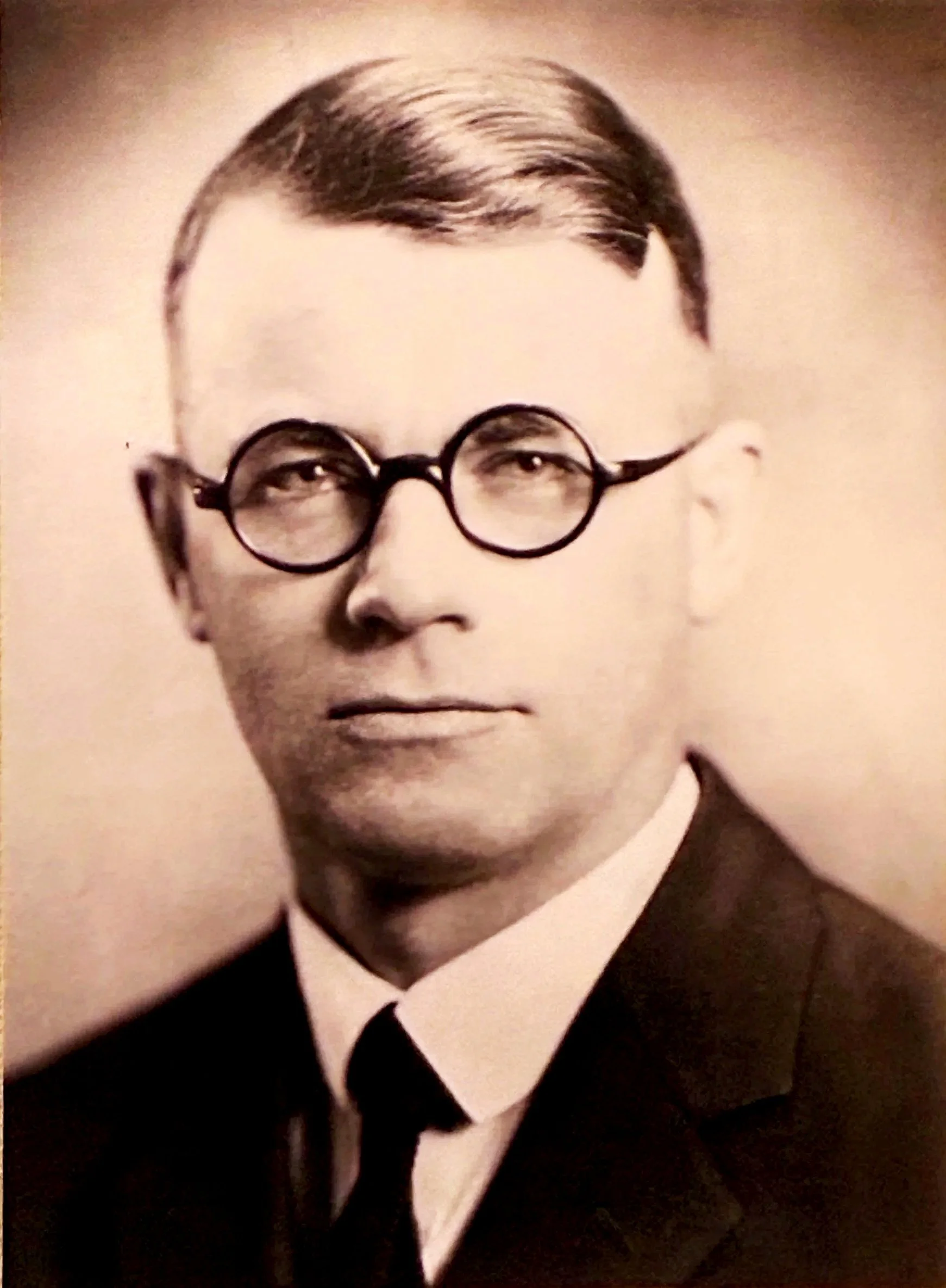
A glass display case nearby features information about Axel Rasmussen and Elizabeth Cole Butler, whose collection was also absorbed the Portland Art Museum. For Axel Rasmussen, there is a headshot photo, along with a newspaper article, a page from a bulletin, and the full-page spread from Life magazine in 1961. A small card beneath these items reads:
“The 1948 purchase of a vast collection amassed by amateur collector Axel Rasmussen (1885 - 1945) was considered a museum highlight for decades. Rasmussen, a school administrator from Indiana who worked in Alaska from 1921-1944, collected primarily Northwest Coast objects.”
The signs are telling: the Rasmussen Collection is a thing of the past. It is an acknowledged, but not celebrated, piece of the Portland Art Museum’s history. The museum’s new cultural contribution to Northwest Coast Indian arts will be through repatriation and fostering contemporary artists.
Looking For Answers
What motivated Axel Rasmussen to create his collection? Was he saving or destroying cultures? Was he motivated by good or by greed?
There may be more questions than answers about Axel Rasmussen. As far as can be found, there has never been a lengthy biographical sketch of Axel Rasmussen. His life has been largely overlooked and overshadowed by his collection.
That his collection took years of steady work, planning, and investment is indicative of his meticulous nature. He was fastidious, upright, and inoffensive in his manners. He encouraged students to do their best through motivational speeches, but he never seemed to speak about himself. His relationships were few but meaningful.
Through his collection of artifacts, Axel Rasmussen became someone who was valued and respected. He capitalized on the public’s interest in curios and Alaska. He dealt directly with Wrangell’s Tlingit elders and earned their trust through repeated trades. He attempted to restore decaying totems and learned everything he could about them. He took a deep personal interest in the craftsmanship of the artifacts he acquired.
As decades at the Portland Art Museum confirmed, Indigenous artifacts are a hit with children. Even very young children recognize expressive carvings of animals with big eyes and wide mouths. Movable pieces could come to life at the pull of a string. Tools and weapons captured the imagination, and large pieces like the feast fish dwarfed children in size. For a man who dedicated his life to working with children, his artifacts provided a novel way to connect with them.
But Axel Rasmussen could be careless. He stored his collection in places like Shakes Island and his museum in Skagway, both of which were not fireproof. He kept collecting even as cancer sapped him of his health. For a measured man, his appetite for collecting was bottomless. His desire to collect seemed to exceed any clear plan for what would become of the collection. Despite being ill for so long, he never completed a will. He left behind notecards about the items in his collection, but he never published that knowledge through articles or books. If there was an ultimate educational goal behind his collection, it failed to materialize upon his death.
Wherever they have been, the items in the Rasmussen collection have done much good. They have inspired and educated people about cultures of the Pacific Northwest coast. They have revealed to new generations of artists ancient techniques and methods. They have rekindled the flame of Indigenous heritage through repatriation. In the end, Axel Rasmussen was only a temporary caretaker of these artifacts, whose stories begin long before they were collected and continue well into the future.
.jpg)