

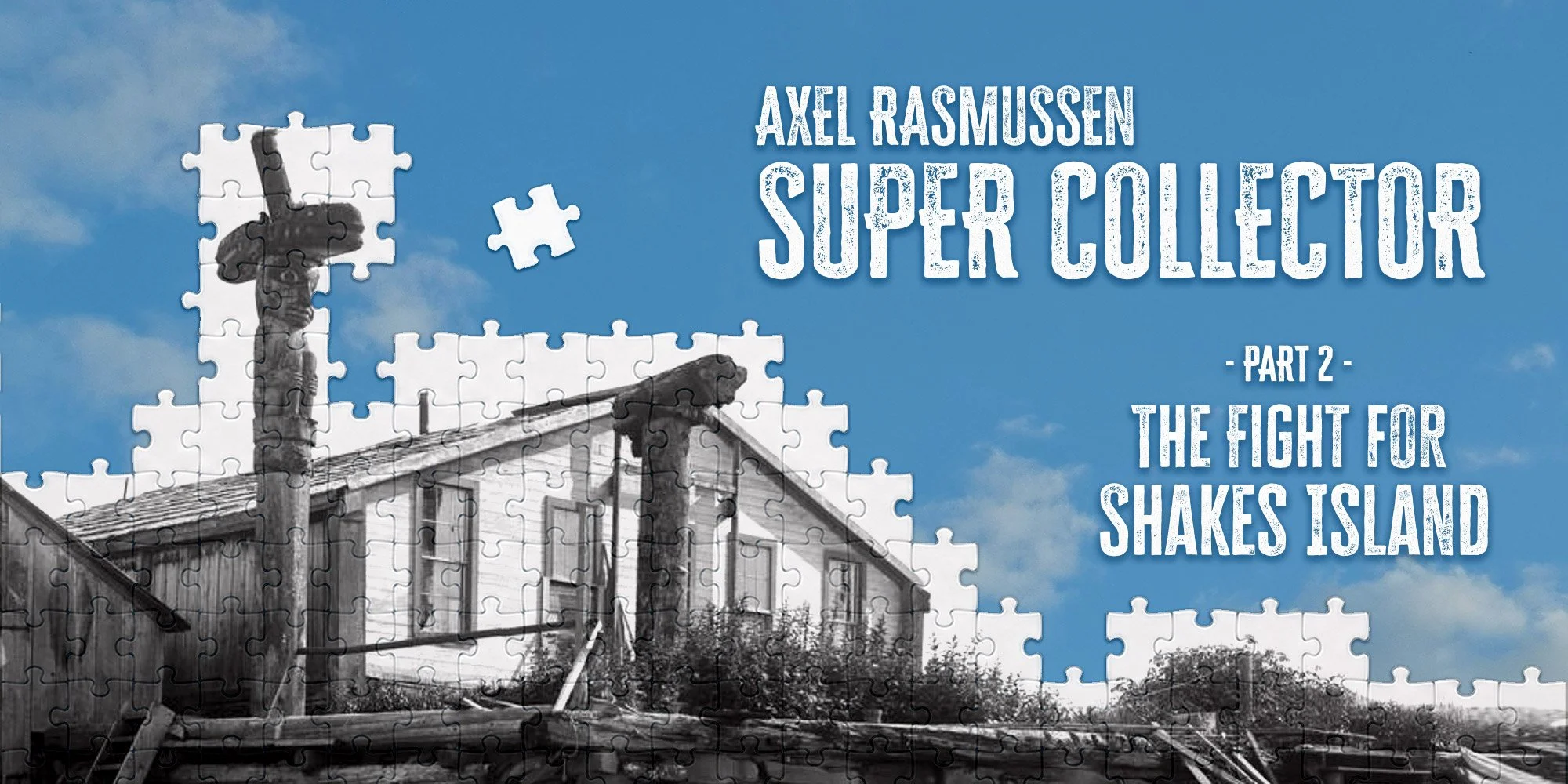
Axel Rasmussen had an ambitious plan to own and operate Shakes Island as a private museum, but his quest to purchase the island came up against resistance from Wrangell locals and the U.S. federal government.
BY RONAN ROONEY • WRANGELL HISTORY UNLOCKED
PUBLISHED SUNDAY, JUNE 7, 2026
← Read Super Collector, Part 1: Axel Rasmussen Goes to Alaska
Mary Shakes (right) greeting tourists at Shakes Island, circa 1920s.
Treasured island
With the death of Mary Shakes in February 1937, one chapter of Wrangell history closed and another began. Her death opened floodgates of speculation about the future of Shakes Island.
The island held great cultural, historical, and economic value to Wrangell. According to an oral history of William Tamaree, Shakes Island was the first piece of land selected in 1833 when the Tlingit and the Russians moved into Etolin Harbor. The Naanya.aayí selected first and chose the piece of land made an island by the high tide. The island’s exclusivity was a fitting status symbol for the wealthiest and most powerful clan in Ḵaachx̱ana.áakʼw.
(image credit: Michael & Carolyn Nore Collection)
Main Tourist Attraction
Shakes Island’s isolation has also meant its preservation. As Wrangell changed, Shakes Island remained the same. For tourists in the 1920s, Shakes Island was the capstone of a voyage to Wrangell. Ships deposited tourists at a dock near the north end of town. As tourists walked down Front Street to Shakes Island, they passed curio shops and places to spend their money. By the time tourists walked back from Shakes Island, it was time for their ship to leave.
Wrangell’s business leaders understood the strategic value of Shakes Island and the opportunities it created. Shakes Island was the crown jewel of Wrangell.
Shakes Island circa 1927. (image credit: Alaska State Library)
And yet, it was unmistakable that Shakes Island had fallen into decay. Mossy, beaten totem poles leaned to the side. Bent planks and broken windows showed the signs of wear. Brush and weeds grew alongside the building. And yet, this only added to the authenticity of experience and continued to attract tourists. Even as Shakes Island started visibly falling apart, tourists flocked to see this authentic piece of Tlingit culture.
This surveyor’s map from 1962 shows Shakes Island, Block 85, and the divider between Lots 2 and 1.
Restricted Deeds
Shakes Island was split into two lots. Mary Shakes owned Lot #2, which was the larger, front-facing portion of the island. This lot included the clan house, two totem poles, and the memorial monument to Moses Shakes. In order for Mary Shakes to sell her deed to Shakes Island, she needed approval from the Department of the Interior. This restricted deed clause was designed to protection officially designated Indian Lands.
Axel Rasmussen’s whole arrangement with Mary Shakes hinged on approval from the Department of the Interior. If the department said yes, Rasmussen stood to claim Wrangell’s most iconic landmark. If they said no, Axel Rasmussen would have been paying Mary Shakes for nothing in exchange. By the time Mary Shakes died in February 1937, Axel Rasmussen had already paid her $580 dollars — well over halfway to the $1,000 goal.
Lot #1 was owned by William Shakinaw, an elderly Tlingit man who agreed to sell his lot to Axel Rasmussen. They agreed on a $250 price, and Rasmussen made a down-payment of $75, along with a promise to pay the rest upon approval from the Department of the Interior.
Barring any interference by the U.S. government, Axel Rasmussen could expect to own Shakes Island as his own private museum and attraction.
B. Frank Heintzleman, Regional Forester of Alaska, U.S. Forest Service. (image credit: US Forest Service)
The Hand of Heintzleman
As the U.S Forest Service’s Regional Forester for Alaska, B. Frank Heintzleman’s job was to promote economic growth wherever he could. The 1930s was the era of the New Deal, and the federal government invested in programs to give Americans jobs through ambitious social programs. In the Pacific Northwest, the Works Progress Administration (WPA) hired Indigenous carvers to preserve and replicate rapidly decaying totems.
While Heintzleman was optimistic about totems for Wrangell, he was unsure about Shakes Island. On September 28, 1938, Heintzleman wrote to Josiah S. Wyckoff, his employee in Petersburg:
“I am much interested in the possible restoration of the totem poles at Wrangell, as discussed in your letter… I think it will be well for you to go to Wrangell and look into the possibilities...
Mr. Chisholm mentioned to me a short time ago the possibility of getting possession of Old Chief Shake’s community house in Wrangell. He said the thing had been bought a number of years ago by Mr. Rasmussen, a former resident of Wrangell, who is now teaching school in Skagway.
I advised him that under no circumstances would we be willing to pay out cash to get control of the property and that if anything were done towards its reconditioning some other agency would have to supply the purchase price and perhaps part of the nonlabor costs.”
Despite his reservations, three months later, Heintzleman and Wyckoff were in Wrangell presenting to an audience of Wrangell’s business and civic leaders about Shakes Island. The Wrangell Sentinel of December 9, 1938 wrote:
“Approximately $15,000 is available for the project, all of which must be used on labor. Mr. Heintzleman pointed out that before anything could be done title must be cleared to Shakes island and the totems to be restored. Also the non labor costs must be met by the community.”
The newspaper reported that, following Heintzleman’s remarks, a seven-person committee formed to address the issue. Though he was not mentioned by name, everyone understood that the pathway to the Shakes Island project was blocked by Axel Rasmussen. They had to act quickly, because the Works Progress Administration money would not last forever.
If Wrangell was going to save Shakes Island, the town would have to pay for it. J.S. Wyckoff composed a telegram to Axel Rasmussen in Skagway, inquiring about whether he might be willing to sell his stake in Shakes Island.
Rasmussen’s Opening Offer: $1,700
On December 8, 1938, Axel Rasmussen replied to J.S. Wyckoff’s inquiry about selling Shakes Island:
“Mr. Wyckoff,
Will see Shakes Community House for seventeen hundred dollars. This includes four corner totem poles inside the house also two totem poles and one marble marker in front of the house.”
The next day, Rasmussen wrote a follow-up letter explaining how he arrived at the $1,700 figure:
“I bought the northwest end of the island from Mrs. Mary Shakes four years ago, paying her $1000 for it. The dividing line is a line parallel to the back of the house and four feet back of it. I spent about $250 for temporary repairs to the roof and floor and have used it as a museum for tourists since then. It has produced an average income of about $400 per summer…
Mr. William Shakinaw sold me part of the other end of the island for $250. $75 of this amount has been paid to him and the balance is to be paid when we get the sanction of the Dept. of the Interior. A strip of 60 or 70 ft. in the middle of the island is still in the possession of the heirs of Mrs. Shakes. I believe they are willing to sell.”
Rasmussen was willing to sell, but his price was steep. And he even acknowledged that he had yet to “get the sanction of the Dept. of the Interior.” As 1938 came to a close, no side was closer to determining who truly owned Shakes Island.
January 1939 kicked off with Wrangell’s Chamber of Commerce meeting to set an agenda for the year ahead. They published a list of action items which ended with, “Took initiative in negotiating for the purchase of Shake’s Island to be turned over to U.S. Government for establishment of National monument.” By the end of the month, the Wrangell Chamber of Commerce appointed Walter C. Waters chairman of the Totem Poles and Shakes Island Project committee.
Wrangell’s business leaders envisioned a Shakes Island that would be for the public good, not for private hands. Sides were forming in the battle for Shakes Island, and Axel Rasmussen was increasingly alone.
(image credit: DaNika Smalley, Wrangell Museum)
Tlingit Claims to Shakes Island
Axel Rasmussen was not the only person to have a claim to Shakes Island. Members of the Naanya.aayí clan could claim ancestral right to the island, throwing a potential legal wrench in the government’s plans to convert the island into a public park.
To secure Shakes Island, the Department of Indian Affairs believed anyone with a legal claim to Shakes Island needed to surrender their rights to it. On February 3, 1939, Wyckoff telegrammed Heintzleman in Juneau,
“Letter from Commission Indian Affairs to [U.S. Commissioner Richard] Suratt indicates settlement Shakes Island subject further delay. Believe tribal rights Non-Ya-Ai-Yee family paramount. Will and deed Mary Shakes can be set aside only by action District Court...
Town of Wrangell ready make settlement Rasmussen any sums advanced Mary Shakes her subsistence.”
At the beginning of March 1939, members of the Naanya.aayí clan signed away their rights to Shakes Island for $1 each. There was Eva Blake, Charlie Jones (the seventh Shakes), William Shakinaw, George Shakes Jr., Emma Larson, James Bradley, Charles Borch, and Elizabeth James.
But Rasmussen was still an unknown. The same day that five of the Naanya.aayí members signed away their rights to Shakes Island, Wrangell’s town council authorized U.S. Forest Service agent Charles G. Burdick to negotiate with Rasmussen on their behalf. The council passed a resolution stating,
“RESOLVED, that Chas. G. Burdick of the U.S. Forest Service be hereby authorized to act as an agent for the Town of Wrangell, Alaska to negotiate with Mr. Axel Rasmussen of Skagway, Alaska to secure a quit claim to whatever interest he may have in Shakes Island at Wrangell, in any sum not to exceed One thousand dollars $1000.00, said sum to be paid by the Town of Wrangell, Alaska when title to such interest is approved by an accepted by the United States.”
The next day, Wrangell’s town council sent Axel Rasmussen a telegram telling him to expect Burdick in Skagway within seven to ten days.
Rasmussen’s New Offer: $800
On March 18, 1939, Axel Rasmussen and Charles Burdick met in Skagway to discuss Shakes Island.
Burdick had several advantages. First, he knew that Rasmussen’s claim was entirely dependent upon approval from the Department of the Interior. Burdick could use that as leverage to induce Rasmussen to sell. Second, Wrangell’s town council had authorized Burdick to pay Rasmussen up to $1,000 for Shakes Island. Burdick could start low and work his way up as negotiations proceeded. Third, Burdick represented the unified force of the U.S. Forest Service and the Wrangell town council, adding weight to his appeal.
During their meeting, Rasmussen abandoned the $1,700 figure. Instead, he asked for $800 for Shakes Island. In a follow-up letter, Rasmussen revealed he’d paid Mary Shakes $580 and spent $148.50 on her funeral and $33 for a taxi, for a total of $761.50. Rasmussen wrote:
“As I told you this afternoon you may have a deed for $800, with the understanding that I am protected against any claims for the balances due Mr. Shakinaw and George Shakes. You stated that you did not think the council will agree, so probably that is that. Anyhow, $800 is the bottom figure and that still leaves me holding the bag. Maybe the balance is tuition in the school of experience.”
Burdick was playing Rasmussen. William Shakinaw and George Shakes had already signed away their claims to Shakes Island, effectively ending any claim they could make against Rasmussen. By withhold this information, Burdick avoided giving Rasmussen leverage in the negotiation. Additionally, Rasmussen’s $800 offer was well below the $1,000 the Wrangell town council authorized Burdick to pay. Rather than immediately agreeing to Rasmussen’s terms, Burdick suggested to Rasmussen that he “did not think the council will agree” to the $800 price. The maneuver allowed Burdick time to contact Wrangell for guidance.
In a telegram the next day to Mayor Fisk in Wrangell, Burdick described his counter-offer to Rasmussen:
“Offered Rasmusson two hundred dollars for quit claim deed regardless of action government takes on his claimed equity or eight hundred dollars in escrow subject to payment if his equity upheld by probate court. He refused and wanted eight hundred dollars on basis two hundred dollar offer. Believe this not fair deal for city so refused as I believe his equity nil. Advise me if city wishes to pay eight hundred dollars for quit claim regardless of legality Rasmussen claim.”
Burdick also sent a telegram to US. Commissioner Richard Suratt in Wrangell. Could not deal with Rasmussen,” wrote Burdick, “so will present Native quit claim deeds for Department Interior consideration. Desire push case soon as possible.”
Burdick was frustrated. Rasmussen’s claim to Shakes Island hung by a thread. Despite this, Wrangell’s town council was highly motivated to secure Shakes Island, even if it meant Wrangell would pay out of pocket for it. On March 21, 1939, Mayor Fisk sent a telegram reply to Burdick:
“If Rasmussen’s interest only obstacle in way to approval of project, council feel justified in accepting his offer and you are authorized to proceed, otherwise project may be held up indefinitely or defeated.”
Frustrated by the lack of clarity and reluctant to pay Rasmussen more than he deserved, Burdick replied to Mayor Fisk:
“Do not know if Rasmusson’s interest only obstacle in way to approval. Strong possibility exists that his quit claim would not hasten settlement as our opinion Interior Department will probably disallow his claim. Other obstacles unknown here may be present to cause indefinite delay so city may pay eight hundred dollars and learn later was unnecessary and not expedite settlement in any way.
Suggest let case set until Heintzleman can discuss with probate division Interior Department and advise us whether their opinion quit claim from Rasmusson should be secured. Appreciate your desire expedite matter but suggest awaiting word from Heintzleman but if you wish secure Rasmusson’s quit claim deed prior word from Heintzleman believe best you deal direct.”
A week later, on March 29, 1939, Burdick reiterated his concerns to his superior, B. Frank Heintzleman. Burdick wrote, “I do not like to see the City pay $800 for this quit claim deed unless Rasmussen has a definite equity...”
Burdick even questioned if what Rasmussen had done was illegal. Burdick pointed out it was a misdemeanor to induce an Indian to part with restricted lands, punishable by fines and imprisonment. “Mr. Rasmussen has purchased both the Shakes and Shakinaw interests which would constitute two cases, but apparently he has been acting in accordance with the best opinions he has been able to secure.”
It was over two years after the death of Mary Shakes, and no one was any closer to saying definitively who owned Shakes Island.
Countdown
As the summer of 1939 approached, Axel Rasmussen returned to Wrangell. The May 26, 1939 Wrangell Sentinel reported, “Mr. Rasmussen next week will open Shakes island communal house for tourist inspection of his collection of Thinglet curios.” If Rasmussen was going to submit to the pressure, he showed no signs of it. It was business as usual.
But Alaska’s Forest Service director B. Frank Heintzleman was optimistic. The same issue of the Wrangell Sentinel reported that Heintzleman believed “the transfer of Shakes Island to the Town of Wrangell is only a matter of short time.”
On June 7, 1939, Wyckoff telegrammed the Juneau Forestry office, “Council and Rasmussen have agreed settlement all claims Shakes Island. Small crew now clearing debris. Suggest Forrest complete plans for buildings. Advisable construction temporary work shop and storage shed on island.”
Department of Interior Declines Rasmussen
After two years of speculation, the U.S. Department of the Interior finally addressed the question of Axel Rasmussen owning Shakes Island. On June 7, 1939, Assistant Commissioner William Zimmerman wrote a long, detailed letter to U.S. Commissioner Richard Suratt. In the letter, Zimmerman spelled out the department’s history with Shakes Island. Buried in the bureaucratic jargon was a single, short mention about Axel Rasmussen’s deed with Mary Shakes “returned without approval.” The letter said:
“With reference to the deeds previously executed by Mary Shakes and William Shakinaw, covering the land involved, on behalf of Axel Rasmussen, it may be said that the records of the General Land Office show that on February 24 the deeds were returned to Mr. Orville E. Shirley, Townsite Trustee, Box 408, Anchorage, Alaska without approval and with a statement that ‘the grantee has the right of appeal.’”
The question everyone had been wondering was now answered. Axel Rasmussen would not get Shakes Island because the U.S. Department of the Interior said no.
Even though he was not legally entitled to Shakes Island, the government still felt it was necessary to get him to sign away his claim to the island. It was too risky to invest time and money into a project that could potentially be derailed by a legal appeal by Rasmussen. As Heintzleman had directed from the start, the title to Shakes Island had to be absolutely owned by the government for any work to proceed.
On June 9, 1939, Axel Rasmussen signed a quitclaim deed to Shakes Island for $800. It was the same amount he had offered Burdick back in March 1939, but which Burdick felt Rasmussen did not deserve. The money came from the town of Wrangell. According to September 8, 1939 Wrangell Sentinel, the city spent $1,025 on “Shakes Island” and $3,000 on “1939 WPA,” a significant sum given the total yearly budget was only $45,000.
With the papers signed, work on restoring Shakes Island began almost immediately.
Kadin Island sittings in the foreground to the right, at the mouth of the Stikine River. (image credit: Mark Beebe)
The Drowning of Richard Johnson
One month after signing away his claim to Shakes Island, Axel Rasmussen was struck by tragedy.
Rasmussen’s foster son, Richard Johnson, was gill-netting near Kadin ("High") Island at the mouth of the Stikine River when he fell into the water. According to the Wrangell Sentinel, eyewitness Henry Heinbockle “saw a splash between the boat and skiff, heard sounds which seemed to him like one crying out in pain rather than for help.” Heinbockle was too late to rescue Johnson, who was swept away by the Stikine River’s powerful undertow.
Axel Rasmussen’s life was touched by the drowning death of a Don Nix, a young Boy Scout in his troop in 1917, and the drowning death of his nephew, Albert Rasmussen, who drowned in Alaska in 1931. As with Richard Johnson, each drowning happened while Rasmussen was somewhere else.
The July 21, 1939 Wrangell Sentinel recognized the “very deep bond of affection and comradeship” between Axel Rasmussen and Richard Johnson. The newspaper listed Johnson’s survivors as “the one person closest to him, his foster father; his young brother Edward [Ned] who for several years has spent his school vacations with Mr. Rasmussen at Wrangell; two sisters and two brothers at Juneau and Sitka, and his mother at Douglas.”
One week later, the Wrangell Sentinel published a message of thanks from Rasmussen co-signed by Ned Johnson:
“Ned and I wish to express our appreciation for the many words of sympathy in the tragic death of our beloved Dick. The past six years of comradeship with him has been a most blessed experience which not all the pain of separation can annul. It comforts us to know that others liked him also and saw the glint of gold in his character.”
At the beginning of 1939, Axel Rasmussen envisioned spending summers with Richard Johnson and running a private museum on Shakes Island. By the end of the year, his dreams were dashed. As Axel Rasmussen lamented what could have been, the Civilian Conservation Corp (CCC) was busy at work on Shakes Island rebuilding, re-carving, and replacing the aging structures with new attractions. By June 1940, the work would be complete and Shakes Island would be reintroduced to the world — all without the participation of Axel Rasmussen.
Over his years in Alaska, Axel Rasmussen had managed to collect hundreds of rare, unique Indigenous artifacts. He earned a reputation as an expert on Indigenous culture. He counted many friends in Wrangell who held him in high regard. But his attempt to purchase Shakes Island was a bridge too far. In the end, his legacy would be for his artifacts, and it was his collection of artifacts that would endure beyond him.