

In our first episode, we look at the life of William King Lear (1832 - 1915). He is best known as the man who owned Fort Wrangel during a gold rush. He defended his claim to own Fort Wrangel for decades, during which time he shaped the Wrangell we know today. (Published Sep 2, 2020)

Introduction
In his day, they called him “King Lear.”
He is a legend of the Alaskan frontier, a myth that turned out to be true. Of all the fortune-seekers to come north after the Alaska Purchase, his lucky strike is among the greatest. And like all the rest, his luck would run out. He goes by the unforgettable name William King Lear.
To this day, he’s known as the man who owned Fort Wrangel. He bought it from the Army, fair and square, and paid $600 for it. But King Lear would learn, once you take a fort, you have to defend it. And yet, when he died, no obituary ran. No tales of this frontier legend appeared in any newspapers in the country.
Today is the life story of William King Lear.
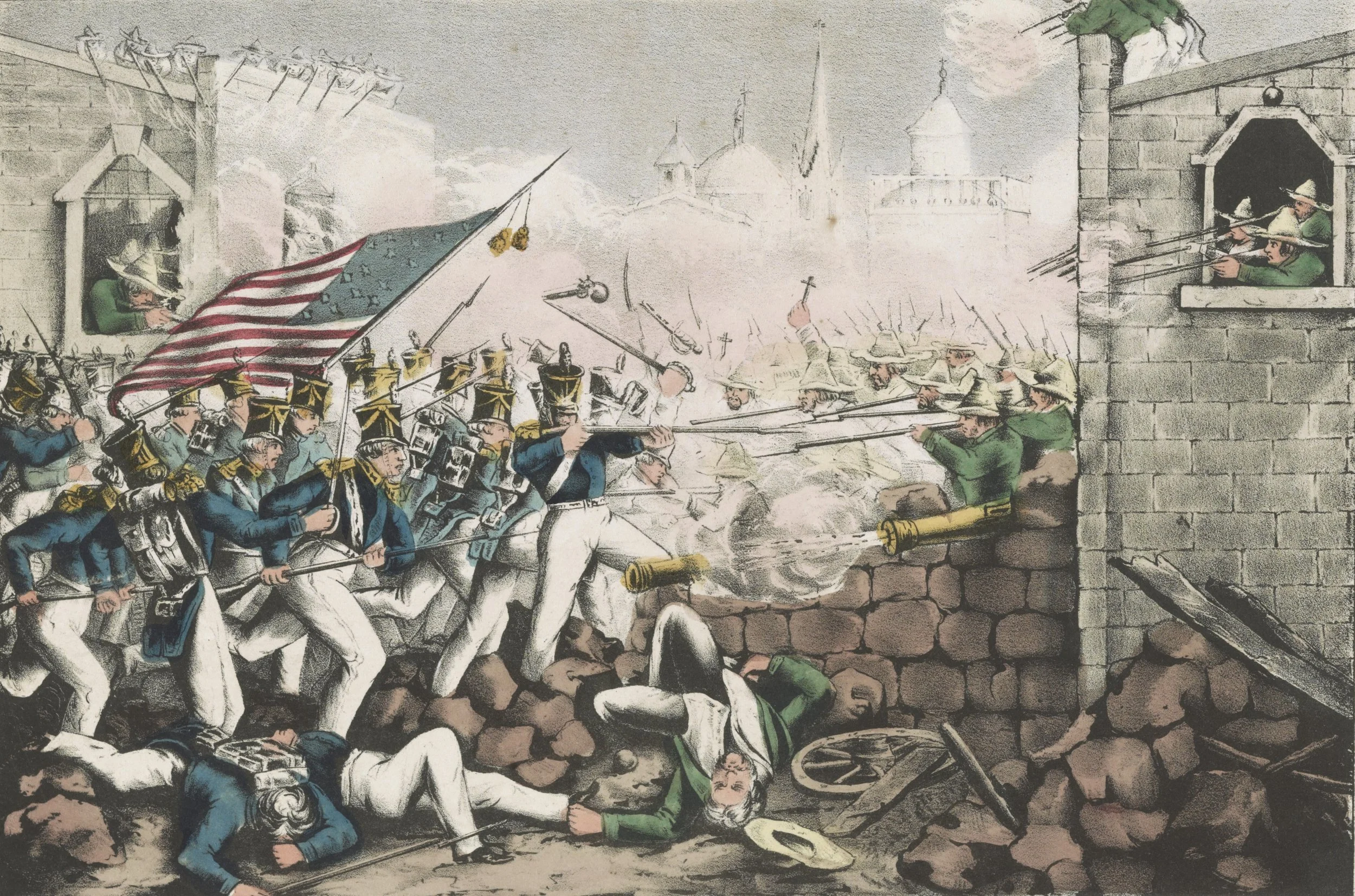
William King Lear’s father, William King, fought and died in the Battle of Monterey. (source: Library of Congress)
Chapter 1. South to North
Early Life
Born in 1832, in Florida, William King Lear was destined for a life in the military. He was the third child of his mother, Almira, and William West Lear, a promising young infantry officer with a mean streak. He once punished a man by ordering him ducked in the harbor so many times the man died. When Lear and his men were arrested, their commander, Colonel William King, ordered Lear released and pressed for no investigation or charges. It was not the first time Colonel William King covered for his young officer.
As a token of respect, William West bestowed upon his son the name of his commander, thus creating a name of Shakespearian proportions: William King Lear.
When young William was 14, Major Lear died from injuries sustained at the Battle of Monterey, California, one of the many bloody battles of the Mexican-American Wars. The news of Major Lear’s passing brought comfort to those who knew it meant an end to his suffering, having sustained a bullet to the face that left a gaping hole, but had failed to kill him on impact. He lingered for five agonizing weeks before succumbing to his wounds.
Military Service
As a young man, William King Lear, like his father and brother before, joined the United States Army. He was sent to Oregon territory and attained the rank of 2nd Lieutenant.
Lear was a lean man of sturdy build. His long, slender nose, bushy beard, and somber eyes gave his features a Lincoln-esque quality. He dressed neatly and parted his hair on the side.
He married an Indigenous woman, Taswatha, the daughter of Cascade Indian Chief Chenoweth. Soon, Lear was forced to choose between his marriage and his duty to the Army.
At the end of March 1856, in a hastily arranged trial, the United States Army sentenced Chief Chenoweth and eight of his tribesmen to death for murder.
Multiple tribes had always lived around the area where the Hood River meets the Columbia River, separating Washington and Oregon. Pressure mounted as White settlers moved into this region, in violation of treaties, setting off bloodshed. Chief Chenoweth’s tribe, the Cascade Indians, were known to be friendly with Whites, and Chief Chenoweth was personally well-liked. Relations between Whites and Chief Chenoweth were strong, and Lear’s marriage to his daughter helped.
Before the barrel was kicked out from under his feet, Chenoweth gave a war whoop, crying, “I am not afraid to die!”
Lear was furious. He resigned his commission in protest on April 1. He was 24. This would not be Lear’s last grievance with frontier Army justice.
Lear and Taswatha had a daughter, Isabelle. Shortly before her birth, Lear abandoned Taswatha and Isabelle and went north to Washington territory. Years later, Isabelle would write about her father’s abandonment:
“My father was here only a short time, and left this part of the country before my birth. In fact, I did not see my father until after I was married and had children. Many young army officers who served in Oregon and Washington prior to the Civil War had Indian wives.”
Fraser River Gold Rush
Lear found his true calling in the Fraser River Gold Rush of 1858, along the U.S.-Canada border. Gold is hard to come by, but customers willing to pay for goods are always to be found in a gold rush. From a history of Blaine, Washington:
“The town on the spit had a hotel, several residences, a number of tents, and a trading post. William King Lear, perhaps the most enterprising resident of the town on the spit, operated the trading post. He also sold property lots, operated the hotel, and ferried men and supplies…”

In August 1868, Eadweard Muybridge captured photographs of Ḵaachx̱ana.áakʼw and the earliest days of Fort Wrangel, still under construction.
Arrival at Fort Wrangel
At the age of 36, William King Lear arrived in Fort Wrangel in September 1868. He would call it home for the next thirty-six years. It was the most consistent thing of his life.
From the shore, he couldn’t miss the Tlingit village, dotted by totem poles, along the coastline. Over 500 people lived in this bustling community, having survived epidemics and waves of White explorers, fortune seekers, and settlers.
Down in the harbor, the old Russian fort stood in ruins, washing away, a fading memory, a reminder of a long, gone foreign power.
Up on the hill, the United States Army erected a new symbol of power: a white, shining fortress sitting astride the sea, flying a Union flag behind a tall picket fence. Fort Wrangel was twelve buildings inside a 200 by 200 foot area. There were quarters for officers and their wives, and barracks for the soldiers. The fort came complete with a bakery, laundry, storage space, and boardwalks between buildings. The prize of fort was the largest building, a two-story hospital with a balcony view of the sea. A boardwalk connected the buildings.
A guardhouse, positioned behind the fence near the entrance, sat facing the the Tlingit village below.
Lear opened shop outside the fort as a post-sutler, a civilian merchant who sells to a military post. The soldiers and wives of the fort became his customers. He sold to them what the Army might not provide, such as tobacco, candy, clothing, even alcohol. In 1868, the year Lear arrived, one receipt shows he sold 83 pounds of onions to the United States Army for $6.75.
Lear entered into a business partnership with another ex-military man, a Confederate naval war hero named Leon Smith. During the Civil War, Smith earned his fame in the Battle of Galveston, Texas, ramming a Union navy ship using one of the infamous “cottonclads.” Four years after the war, Smith found himself in the north—the far north, with his wife and young son.
Together, Smith and Lear ran a trading post with one special feature: a bowling alley.
Before the year was over, Leon Smith would be dead. And his death would foreshadow the end of the Army in Fort Wrangel, and the ascent of William King Lear.

Chapter 2. Trouble in Fort Wrangel
The Bombardment
It was Christmas Day, 1869. Under a thin layer of snow, and the cover of night, a party raged inside the officer’s quarters of Fort Wrangel.
This was first Christmas celebrated at Fort Wrangel, and the officers away from home marked the occasion with four guests from the Tlingit village: two brothers (Shawaan and Isteen), Shawaan’s wife Kchok-een, and Kchok-een’s sister.
Downstairs, Angelina Muller, the London-born wife of Sergeant Jacob Muller, avoided the Christmas party all together. She worked at the fort as a laundress, and she cared for their sons, Jacob and George Oscar, the latter born less than a year before at Fort Wrangel.
Angelina heard the drunken, boisterous laughter of the party upstairs turn into shouting. She heard the shrieks of a woman tumbling down the stairs. Angelina came out of her room and rushed to Kchok-een’s side. In pursuit came her husband, Shawaan, the culprit. Angelina rushed Kchok-een into her room and shut the door, but Shawaan tried to push his way in. Angelina reached out to push away Shawaan’s face. In the struggle, his teeth came down, and bit one of her fingers off.
Almost immediately, the soldiers shot and killed Shawaan and his brother, Isteen.
Asleep at home, Tlingit chief Shx’atoo was woken with the news by his wife. Shawaan and Isteen’s deaths created a chaotic rift in the honor-bound system of Tlingit law. In order to restore the balance, Shx’atoo grabbed his rifle, put on his coat, and went out in the middle of the night to kill a white man. Any white man would do.
And that man would be Leon Smith.
In the still, night hours after Christmas Day, Shx’atoo saw Leon Smith pacing the porch in front of the business he shared with William King Lear. Using his rifle, Shx’atoo shot Smith. The shot hit Smith 14 places along the torso, 3 in the wrist. Years later, Smith’s son would write his father died in an “Indian ambush.”
Smith would not be found until the morning. And when they found him, he was barely alive. He died later that night.
Lear faced the chilling thought that it could have just as easily been him on that porch that night.
The Fort Wrangel commander demanded the chiefs of the Tlingit village turn over Shx’atoo. When they did not, the fort began firing guns and cannons upon the village, destroying homes, lasting for hours until sunset. Many of the Tlingit villagers, including children, fled into the hills behind the village, away from the reach of the fort’s artillery.
With the village devastated, Shx’atoo finally surrendered. The army commander ordered him court-martialed. The commander appointed himself to a jury, along with two senior officers, the fort surgeon, and a civilian they all knew and trusted: William King Lear.
The jury found Shx'atoo guilty of the murder of Leon Smith, and ordered him hanged.
There may have been echoes of the past for Lear. Some thirteen years earlier, a hastily arranged military trial ordered his father-in-law, Chief Chenoweth, hanged. Here in Fort Wrangel, another hastily arranged military trial ordered an Indigenous chief hanged.
Chief Chenoweth famously showed no fear in death. Here, in Fort Wrangel, Shx'atoo showed no fear, either. He performed a brief, sad song for the watching audience. He refused a mask, put the noose around his own neck, and jumped.
Shx’atoo is the first person executed in Alaska by the United States.
The Government Investigates
News traveled slowly in 1870, but it only took three months before members of Congress asked the Department of War to investigate what was already being called The Bombardment of Wrangel.
A month later, in April 1870, Congress had its report. And it was brutal. Known as the Colyer Report, it contained written testimony from the officers involved, and conspicuously no testimony from anyone in the Tlingit village. And still, the Colyer Report excoriated the conduct of the officers involved. The report said the soldiers were the worst problem in Alaska, that they morally corrupted the Natives with alcohol. The report said everyone would be better off if no garrison was stationed in Fort Wrangel at all.
President Ulysses Grant, and a war-weary nation, simply had no appetite for front-page news like this. Alaska was supposed to be an exciting, profitable frontier, not another battlefield.
Lear Appointed Caretaker
The Army dropped the news in the summer of 1870: the garrison was to vacate Fort Wrangel completely.
What would King Lear, the post-sutler, do now? His partner, Leon Smith was dead. And the people of the fort were leaving. The economic prospects for King Lear looked grim.
King Lear was not just a man who sold goods to the people in the fort.
The Army was in Lear’s blood, he understood it, he had lived it, and he knew it well. He stood by the men inside Fort Wrangel during the bombardment and was honored, as a civilian, to participate in the jury to avenge his business partner, Leon Smith.
Where Washington, D.C. was in open rebuke of the officers at Fort Wrangel, William King Lear was on their side.
Before leaving for good, the departing officers made King Lear caretaker. It came with a modest title, agent of the Quartermaster’s Department.
Lear Buys the Fort
The legality of what happened next would be debated for years by lawyers, bureaucrats, judges, and most of all, King Lear himself. But everyone agrees, this is how it happened.
In 1871, while Lear was caretaker, General Canby in Washington, D.C. ordered the fort put up for sale. The U.S. Quartermaster, based in Portland accepted sealed bids on the sale of Fort Wrangel until July 1, 1871. The Army printed posters advertising the sale, including 25 copies sent directly to the fort’s caretaker, a man named William King Lear. By the deadline, the government received one bid: $600, from William King Lear. They accepted the bid, and King Lear paid.
In today’s dollars, Lear got a half-million dollar fort for around $10,000.
How did Lear manage to snag such a prize, at such a price? Perhaps, there was little interest speculating in forts along the Alaskan frontier. Perhaps Lear never showed anybody his posters.
Regardless, the fort was his. Twelve buildings, his choice of bedroom, and beautiful views of Zimovia Straight. Lear had abundant space to turn a business. The post-sutler had became the post owner.
Lots of people came to Alaska looking for a lucky strike. Lear found his. Everyone seemed to lose in the bombardment. But William King Lear came out of it with a fort.

Chapter 3. Putting the Fort to Work
W.K. Lear & Co.
King Lear faced a conundrum. He now owned a large, spacious fort along the Alaskan frontier. He owned bedrooms, storage spaces, and gathering spaces. But how to make anything of it? He needed people.
King Lear regularly published two ads a Victoria, British Columbia newspaper, sometimes under the name “W.K. Lear & Co.” For miners, he offered a “Large Safe and Commodious Warehouse.” In capital, bold letters, his ad asserted, “Will pay strict attention to the business.” In the other ad, Lear advertised himself as a dealer in: groceries, provisions, wines, liquors, clothing, miners outfits, and “everything requisite.” A Pennsylvania paper described him as an “Indian trader bearing the deathless name of King Lear.” It continues,
“[Lear] dispenses calico, beads, blankets, flour, groceries, shoe-blacking, tooth-brushes… fine combs, and Hall’s Sicilian “hair restorer” to the Aborigines, in exchange for furs and skins.”
While other merchants around the fort, like the late Leon Smith, were caught distributing alcohol to Natives, Lear seems to have avoided that particular criminal charge. There is little doubt that Lear must have taken part in the debauchery of the Gold Rush. His ability to grant great favors may have protected him.
For a time, Lear converted the former hospital into a dancehall, and his success as a businessman suggests he embraced, rather than eschewed, the profitable vices of his day.
For the first few years, Fort Wrangel did modest business. Then, in 1873, with news of gold up the Stikine River in the Cassiar, Lear took a steamship down to Victoria, British Columbia to get the newspapers to cover it and drum up excitement.
Throngs of fortune-seekers descended upon Fort Wrangel before going up the Stikine River to the Cassiar. David Wharton, author of They Don’t Speak Russian in Alaska, colorfully imagines what it was like to be a miner in Fort Wrangel:
“They played faro and poker, and gambled on the roulette wheels. In between bets, they danced, stomping with more energy than grace to the flimsy tunes of scraping fiddles… They feasted on stewed tomatoes, roasted moose, potatoes, biscuits, canned peaches…
They went on King Lear’s books for grub, and holed up for the winter. Credit was easy, especially from wizened, war-hardened, ex-sutler Lear, who had a heart as big as a… giant brown bear.
Besides, there was plenty of gold back in the mountains. Nobody was going to skip out without settling his account. There was no way to go, except through Wrangell, and every ship’s passenger manifest was public knowledge.”
The excitement of another Gold Rush, and the money changing hands, drew the attention of the United States government. On September 18, 1874, the Army sent 2nd Lieutenant A.B. Dyer to Fort Wrangel.
And William King Lear was there to greet him with dollar signs in his eyes.
Government Seizes Fort
King Lear had been close with the first group of Army men at Fort Wrangel. They treated him well, and with respect. But they had all gone, and now, a new Army man stood in front of him, 2nd Lieutenant A.B. Dyer, 22 years old.
King Lear could tell things were going to be different. A.B. Dyer was 22, less than a year out of West Point, he was too young to have served in the Civil War. The fresh, new gold tassels of his uniform still glistened. Coincidentally, Dyer was the same rank, and close to the same age, as King Lear when he resigned his commission. Both Lear and Dyer had fathers who were famous majors, as well.
When Dyer arrived, he let King Lear maintain control of the fort, but he began issuing edicts, attempting to corral the wild mayhem brought by the Gold Rush. Dyer’s arrival represented a heightened level of scrutiny from the federal government, and a threat to King Lear’s unchecked power.
The Daily Colonist, writing from Victoria, British Columbia, wondered if Lear saw an opportunity:
“[A.B. Dyer] has been the guest of Mr. Lear since his arrival here… There may be a wheel within a wheel in Mr. Lear’s attentiveness. Suppose this young Lieutenant should use his influence with the commanding officer of Sitka to have Fort Wrangel re-occupied by U.S. troops, and suppose the commanding officer at Sitka should recommend the purchase of Fort Wrangel by the Government as being a necessity, what then would be the result? Certainly nothing more than that Mr. Lear would get his price for those dilapidated old buildings, and all over and above that would be a “consideration” for services rendered.”
Instead, A.B. Dyer was a harbinger of things to come. The Army was interested in Fort Wrangel, but they were not interested in King Lear. One year after Dyer arrived, the August 7, 1875 Morning Oregonian reported:
“Capt Joslyn, Lieut. Moore and Lieut. Williams, with 40 enlisted men of the 21st infantry, will proceed as far as Fort Wrangel and garrison that post, which has by recent order been re-established.”
Weeks later, having arrived at Fort Wrangel and seizing control of the buildings, the officers met as a board. They fixed a monthly rental price of $85 per month, and paid him in vouchers. They also estimated the fort, only five years old, was worth only $7,000.
King Lear protested, demanding $200 per month. Later, he insisted his demand was $225 a month in gold dust, and that he would only sell the fort for $50,000.
Debt, Death, and Departure
King Lear still owned the fort, even if his renters paid only a fraction of what he asked. Lear invested in his merchant business in Fort Wrangel.
At the bottom of the hill from the fort, along the coastline, he built the first wharf, so steamships could dock. This meant people and cargo did not have to be transferred to canoes to come to shore. It is the site of City Dock today.
In 1875, King Lear’s name was first of 85 businessmen, petitioning the Secretary of War to allow them to sell alcohol. They asked the Secretary,
“to allow of a limited number of permits for the sale of liquors and wines to such firms and business house, or individuals whose character and standing guarantee their honest observance of all engagements.”
In the winter after the Army came back, King Lear began taking large loans. On November 21, 1874, King Lear borrowed $2,000 from from two lenders. On January 1, 1876, he borrowed $2,370 from seven different lenders. The borrowing continued through January 1879, ranging from $1,500 down to $30, and always occurred during the winter slow season. He borrowed under the belief that he owned Fort Wrangel and could use it as collateral.
Around this time, records suggest King Lear married a Native woman named Matilda. Little is known about her, and tragically, she died in 1877. For the rest of his life, Lear marked his marital status on the Census as “Widowed.” Records suggest King Lear had three children at Fort Wrangel, at least one with Matilda. It is unclear that Lear raised these children, and the evidence suggests they may have been raised by their Native families.
King Lear’s financial troubles caused him to sell much of the control of his business to a Portland businessman named John Vanderbilt, who became an enthusiastic supporter of the Presbyterian missionaries.
King Lear’s renters, the United States Army, did not stay long. Arriving in 1875, they departed in 1877. Right before the Army departed, the Daily Alta California reported,
“By withdrawing the soldiers, it is claimed, there will be little or no protection to property and life… Should the order be enforced, the withdrawal of troops will have a very damaging effect on trade between Alaskan ports and the outside commercial world. There appears to be a general protest against the proposed action of the Government.”
And just a few weeks later, “At Fort Wrangell there is much depression. There is no one left to settle disputes.”
In Washington, D.C., the nation’s leaders attempted to figure out what to do with Alaska. Ten years earlier, when they put the Department of War in charge of Alaska, and that’s what they got: war. Fort Wrangel was not the only place to bombard its Alaska Native neighbors. Alaska was purchased with the intention of profitability.
To that end, the federal government transferred control of Alaska to the customs officers, collection agents, and clerks of the U.S. Department of the Treasury. nstead of permanent forts dotting the coastline, roving steamships with cannons could enforce government rule more simply, effectively, and without conflict arising from a permanent fort.
The last time the garrison left For Wrangel, it made Lear caretaker. This time, after the Cassiar Gold Rush, it was different. In a parting shot, the Army gave away two of Lear’s buildings to the Presbyterian missionaries: the 2-story hospital building, the largest structure of Fort Wrangel, and the barracks building nearby.
Lear’s old dancehall would become an industrial school for girls run by Presbyterian missionary Amanda R. McFarland.
On June 21st, 1884, acting on advice from Washington, D.C., the deputy collector of customs in Fort Wrangel declared the remaining fort buildings property of the United States, and he demanded Lear surrender the buildings to the customs officer. Lear refused. Four days later, the deputy collector seized the fort buildings by force, permanently evicting Lear from his property.
For years, Lear let the Treasury use space in the fort for free. Now, the same department evicted him and said he wasn’t the owner.
And then in August, the years of borrowing finally caught up with Lear. Portland-area businessman, Max Goldsmith, purchased fifteen of Lear’s loans, taken between 1874 and 1879, totaling $10,464.01. Goldsmith sued Lear for the unpaid promissory notes and asked the court to attach to his property.
There was one thing left for Lear to do. William King Lear sued the government.
Chapter 4. W.K. Lear vs. The United States
A Just and Plain Claim
According to a special correspondent in Alaska in 1884 for the St. Louis Globe-Democrat,
“Mr. Lear has a just and plain claim against the War Department for damages.”
It continued,
“…Rents for stores and warehouse were extravagantly high, and every shed could bring a fabulous price. The unhappy owner, who rejoices in the euphonious name of W. King Lear, could only gnash his teeth and violently protest against the monthly warrants and vouchers given humbly the commandant of the post.”
When the Army gave away Lear’s two buildings to the Presbyterian mission in 1877, it drew the attention of New York City’s The Sun newspaper. The paper noted how peculiar it was that no buildings were converted to public use, only to the private hands of the Presbyterian mission. Nobody else, not even the much smaller Catholic mission at Fort Wrangel, was even given an opportunity to bid or participate in the process. Said the paper,
“If subordinate officials in the department are at liberty to bestow the public property for private for sectarian purposes without legal authority, it is well that Congress and the public should know it.”
Lear sued the government, and would not get his judgement until 1892, 21 years after purchasing Fort Wrangel from the Army.
In his lawsuit, Lear petitioned the Court to grant one of three requests.
The government buys back the fort for $7,000.
The government pays the 8 years of rent he should be owed since the Deputy Collector seized the buildings.
The government simply returns the original $600 purchase, at 6% interest.
Notably, in none of these requests, did Lear ask for possession or ownership of Fort Wrangel. At this point, Fort Wrangel was not the prize it used to be. By the time the judge handed down his decision, Fort Wrangel had seen over two decades, with the mosses, lichens, and rot to prove it. Lear wanted money.
Judgement
In 1892, at the age of 60, Lear got his ruling. The judge reviewed the facts of the case, agreeing with many of Lear’s points.
Yes, “by authority of the secretary of war… the chief quartermaster advertised the buildings for sale.”
Yes, “on 23rd of August, 1871, they were sold to Lear for $600.”
But, said the judge, there is a higher law: Congress must ratify the sale of a fort. Without that, the sale is invalid. The judge ruled the sale of Fort Wrangel null and void.
To Lear’s first two requests, since the fort was rightfully, and therefore always had been, federal government property, Lear had no claim to demand payment or rent.
To Lear’s third petition, to return the original $600 purchase at 6% interest, the judge said yes. This was small victory for Lear, but it came with the stinging implication that he had never truly owned Fort Wrangel.
Life Goes On
In Wrangell, Alaska today, at the corner of Fort Street and Federal Way, is the Post Office, and the former site of Fort Wrangel. William King Lear was Fort Wrangel’s first postmaster. It was a position he would hold several times, and share with his son.
Even after he lost Fort Wrangel, his name was synonymous with the place. Multiple newspaper writers, on special assignment to north, wrote about tours from a man who called himself “King Lear.” When ex-mariner Van Buskirk visited Wrangell in 1896, wrote,
“[Lear] takes meals in the restaurant, invites me to his house, which is also his office, and there kindly presents me with a mineral specimen—Garnet in the rock.”
Lear remained a prominent member of the community, even without Fort Wrangel under his personal control.
In the 1900 Census for Fort Wrangel, William King Lear, 68, was still working as a merchant and lived at the home of his daughter, Mamie, and her husband. When then form asked what profession he had before coming to Alaska, he listed “Soldier.”
In 1903, Wrangell officially became a city. It dropped the word “Fort” from its name forever. The fort, like King Lear himself, was a legend.
One year later, Lear left the City of Wrangell for the last time.

Chapter 5. Dignity in Death
Where The Dead Have No Names
There is a cemetery in Washington state, outside the grounds of the former Western State Hospital, a mental institution. For 77 years, starting in 1876, the hospital buried the remains of unclaimed patients in plots under nameless, numbered markers. By law, only the hospital knew the final resting place of these men and women.
In recent times, a group formed to change this: the Grave Concerns Association. They wanted to fight the stigma against mental illness. In 2004, they fought and won to change the state law, allowing the people buried in this cemetery to have names.
Among the 3,200 graves at Western State Hospital Memorial Cemetery, is number 1-3-9-0: William King Lear. Died 1915.
No paper published an obituary when William King Lear died, because nobody knew it happened. No one recounted this frontier legend, with the unforgettable name, in any newspaper.
So let this stand as an obituary to William King Lear.
An Obituary
William King Lear, former merchant of Wrangel, Alaska, passed away at the age of 83 at Western State Hospital in Washington. Born in Florida in 1832, Lear served as a 2nd Lieutenant in the army in Oregon and Washington. He became a merchant trader along the Fraser River before heading north to Fort Wrangel shortly after the Alaska Purchase. Though the government would dispute it, Lear purchased Fort Wrangel in 1871 for $600. Lear became a leading citizen, building the first wharf, becoming the first postmaster, and working through his 60s. He moved to Seattle, and worked as a watchman in the U.S. Quartermaster’s Department, Pier 5. He spent at least five of his final years as a patient in Western State Hospital before passing in 1915. In his life, Lear had marriages to three Indigenous women, producing children each time. William King Lear is survived by hundreds of descendants.
Listen On:
Pandora | Spotify | YouTube | Amazon Music | Apple Podcasts | Audible | Stitcher
Next in the Timeline:
Strange Customs follows King Lear as the Cassiar Gold Rush brings a corrupt Collector of Customs that threatens his power.