

🪵 Part of a Series on Wrangell Totems 🪵
The house of Kadashan was an impressive two-story home owned by Kadashan, head of the Khaasx’agweidí. What made his house iconic were the two, towering totems in front bearing his name.
BY RONAN ROONEY • WRANGELL HISTORY UNLOCKED
PUBLISHED MARCH 13, 2026
#1. Traditional Clan house
This may be the earliest known photograph of the Kadashan totem poles, taken in 1868 by Eadweard Muybridge. The totem poles stand in front of the home of Kadashan, head of the Khaasx’agweidí clan and a highly influential figure in Wrangell history (see LandBack 1898: Kadashan Confronts the Past).
On the right side of this photograph is the Red Snapper Totem Pole which features a bird with a long, protruding beak. To the left is the Crane Totem Pole with a smooth, round head of a bird at the top.
The design of the Crane Pole began as a walking cane. According to a press release from The Central Council of the Tlingit & Haida Indian Tribes of Alaska, “The cedar cane was masterfully carved by Albert Edward Edenshaw (Git’aalhjuu) 1810-1894. It measures 58 inches in length and is adorned with carved animal and human figures.” The design of the 58-inch cane was adapted into a full-sized totem pole sometime before 1868. In recent years, the cane was repatriated back to Wrangell through a NAGPRA application.
In this undated photo, the structure which formerly stood behind the Kadashan poles is gone. (image source: British Columbia Archives)
This photograph was reportedly taken in 1886. A new, traditional-style clan house building stands behind the Kadashan poles, and a rectangular rock retaining wall (dry stack ledge) stands in front of the Kadashan poles. (image credit: City of Vancouver Archives)
#2. Victorian Style Hosue
This photograph shows the Kadashan house with the front door still under construction. A blanket drapes the entryway while a step-ladder serves as the front steps.
According to Monuments in Cedar by E.L. Keithahn, The Alaskan newspaper of July 23, 1887 wrote, “An Indian named Kadashan is having built a two-story residence on the site of his old house, with two sets of bay windows above and below. The building is a frame one covered with rustic with building paper under it. It will be finished inside with lumber and looks as if it will be one of the nicest in the country. Beat that if you can.” (image credit: British Columbia Archives)
By overlaying the 1914 Sanborn fire map on top of a modern-day satellite image of Wrangell, we can see that the Kadashan house once stood in the area that his currently the Wrangell Marine Service Center.
(image credit: City of Vancouver Archives)
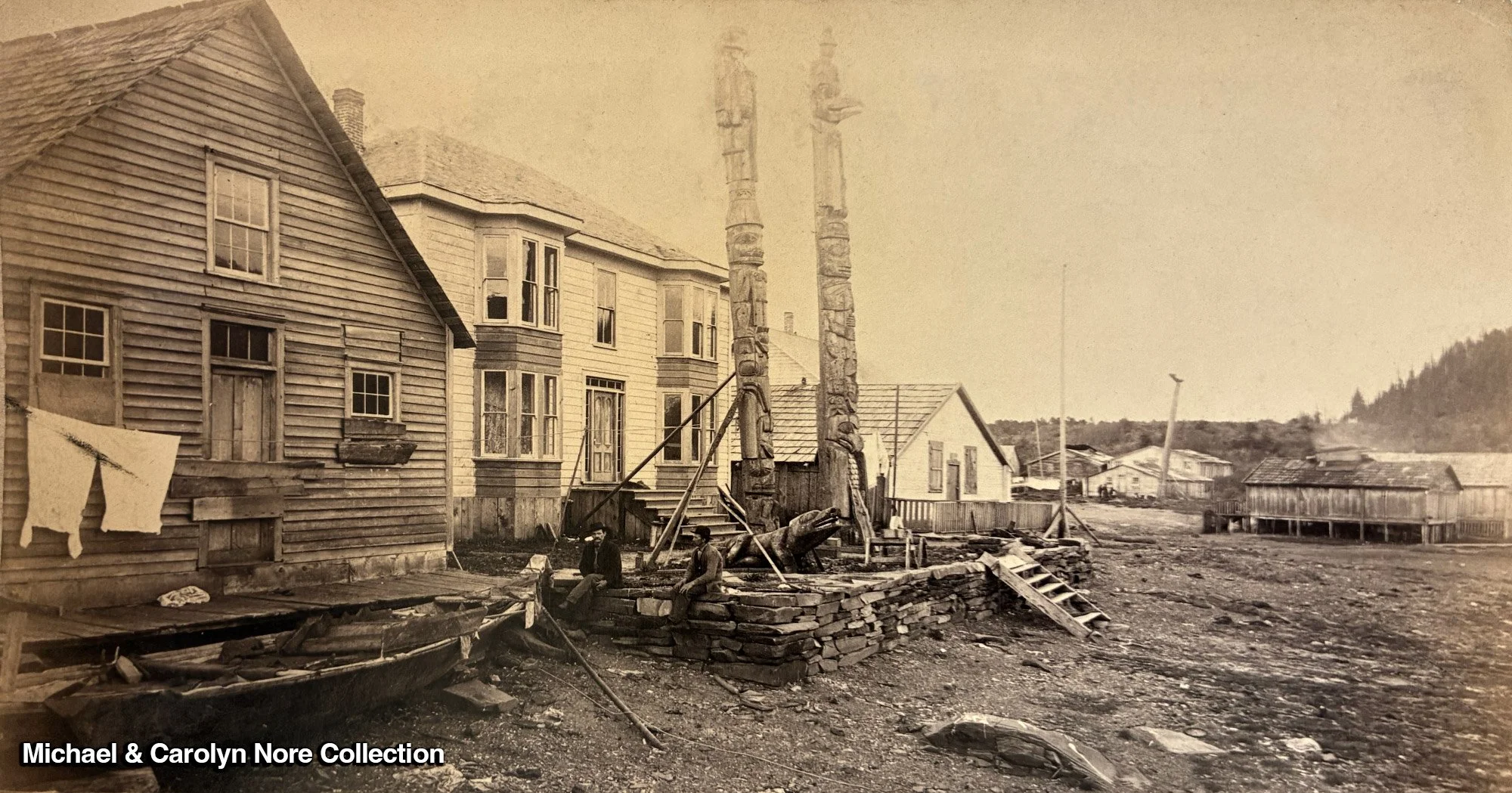
Shortly after completion of the new Kadashan home, the Wolf Grave Totem was moved from its waterfront location and placed to the right of the two Kadashan totem poles. Additionally, supports were added behind the Crane Pole to keep it from falling over. (image credit: Michael & Carolyn Nore Collection)
In his 1887 annual report to the Secretary of the Interior, Alaska Governor A.P. Swineford heaped praise on Kadashan’s house:
“In southeastern Alaska the natives are largely employed by the white people in various kinds of work, and generally receive fair wages. They are not only provident and self-sustaining people, but to a large extent ambitious of bettering their condition by adopting civilized ways of living and providing for the education of their children. As fast as they can accumulate the means they tear down their old houses and build new ones of more modern style. One of these, recently completed by a native at Wrangell, is the finest and most pretentious private residence I have seen anywhere in the Territory.”
At some point in the 1890s, the house to the right of Kadashan’s house was replaced with a large, rectangular shed. The Willson & Sylvester sawmill was rapidly expanding its physical footprint around the Kadashan house. Stacks of lumber begin appearing in photographs from this era. Despite this, tourists hurried to visit the home of Kadashan where they could capture an image of three Indian carvings in a single photograph.
Photographers Winter & Pond, based out of Juneau, captured some of southeast Alaska’s most iconic images. They converted one of their photographs into an etching which they printed on the back of all their photographs. (image credit: Michael & Carolyn Nore Collection)
In 1898, photographer A.C. Pillsbury visited Fort Wrangel to take photos of the Klondike Gold Rush. He captured several photos of the Kadashan poles, including two photos featuring women sitting on the Wolf Grave Totem. Around this time, the front door of the Kadashan home features a slanted awning over the door. (Photo credit: Wikipedia Commons)
At some point after 1898, the slanted awning over the front door was replaced by a more elaborate porch, with enough room to fit planter boxes. Notice there is no support holding up the Crane Totem. (image credit: Michael & Carolyn Nore Collection)
This photograph by Harlan Ingersoll Smith was reportedly taken in August 1909. By this time, the beak off the Red Snapper totem pole had fallen off. (image credit: American Museum of Natural History)
On February 7, 1914, John Kadashan passed away. The February 12, 1914 Wrangell Sentinel wrote:
“One of the best known natives of the Thlinget tribe, John Kadishan, died last Thursday of an attack of pneumonia. Kadishan had just returned from a short trip to Juneau at which place he contracted a bad cold which turned to pneumonia shortly after arriving home and which resulted in his death. Kadishan was a man highly respected in the Thlinget tribe and one of their best native orators.”
While most photographers captured the Kadashan Totem Poles from the front or at an angle, this is one of the few photographs of the totem poles from the side. At this angle, the totems look worn and aged. The Crane Pole leans back further than the Red Snapper Pole and requires a support attached to the second story of the house. (image credit: Michael & Carolyn Nore Collection)
By the 1920s, the Kadashan house had fallen into advanced decay. The Red Snapper pole leans even further back, supported by a temporary board from an upstairs window in the front of the house. Shrubbery grows from exposed areas of earth around the house.
On April 26, 1925 the Milwaukee Journal featured an article on Wrangell’s totem poles, including a photograph of the Kadashan totem poles. This is one of the last photographs of the Kadashan totem poles in this spot. The caption reads, “Pair of ancient totem landmarks in front of Chief Kadashan’s hut at Wrangell, Alaska, one recounting the family’s lineage and the other being a conventional story of creation.”
#3. near Kiks.ádi Totem Pole
in 1926, the Kadashan Totem Poles were removed from their location in front of Kadashan’s house, and the house was demolished not long later. The sawmill had expanded to such a point that it was no longer practical to keep a house there, and the risk of fire from the home spreading to the sawmill was too great.
The May 13, 1926 Wrangell Sentinel wrote, “These relics were very carefully lowered from their positions, placed on trucks and moved to sheltered quarters where they were carefully diagnosed and reconstructed—technically called surgery—wherever toes, wings, noses, or other conventional features were needed; they were then given a generous coating of Portland cement to preserve and bring out the lineaments; and finally, the mythological figures were painted in characteristic colors.” (image source: Book of Pictures of “The Last Frontier,” With Cartoons and Alaska Oddities, 1941)
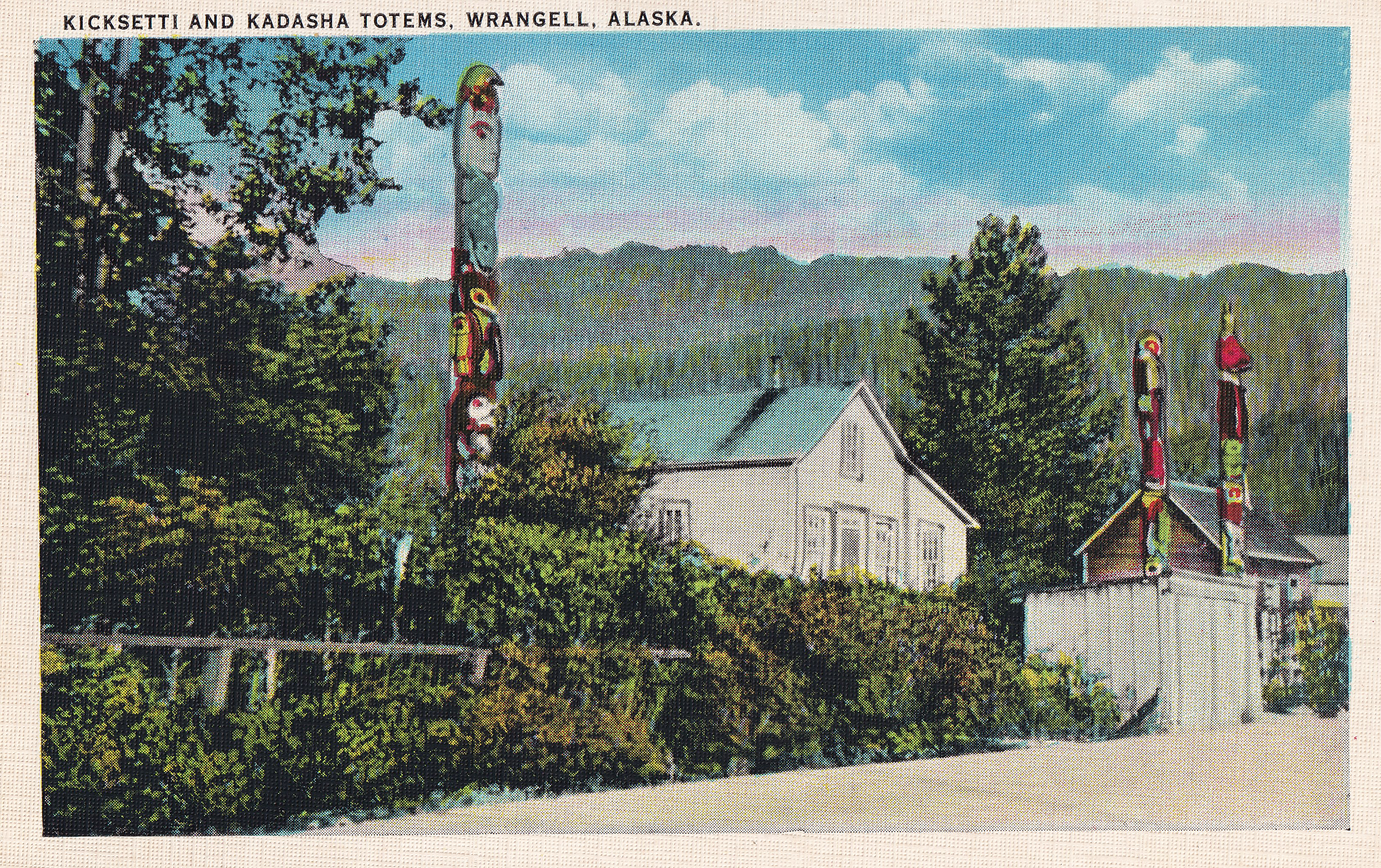
The new location of the Kadashan Totem Poles put them in line with the Kiks.ádi Totem Pole, a short distance to the north. The Kiks.ádi Totem Pole today still stands in the original spot it stood when this photograph was taken.
By placing the 1914 Sanborn Fire map over a modern satellite photo of Wrangell, we can approximate the location of the Kadashan poles in the 1920s.
Despite the cosmetic makeover, the Kadashan Poles continued to age and show signs of wear. By the end of the 1930s, these poles had been standing for at least half a century.
#4. Shakes Island
In 1939, as part of a government New Deal program, the Civilian Conservation Corps (CCC) undertook an ambitious program to create replicas totem poles across southeast in Alaska. In Wrangell, the CCC replica totem poles were placed on Shakes Island. Replicas of the Kadashan Totem Poles were placed on the eastern side of Shakes Island, behind the clan house. (image source: Living New Deal)
For many years, a dock sat between the two Kadashan Totem Poles on Shakes Island.
In this snowy photograph from 1998, it is clear that the dock access has been removed from Shakes Island. A few decades later, these totem poles would be brought down for safety and preservation concerns and placed into storage. (image credit: Wikipedia Commons)
#5. Totem Park
In July 2025, Wrangell hosted a large gathering to raise a replica of the Crane Totem Pole at Totem Park along Wrangell’s Front Street. The totem pole was among five carving raised during the weekend and served as part of a larger apprenticeship program. (image credit: Alice Rooney)
Watch this video from the Central Council of Tlingit & Haida Indians to learn more:
(image credit: Alice Rooney)