

By Ronan Rooney • Wrangell History Unlocked
Published October 27, 2026
“Hey Ronan,
Where does the name ‘Devil’s Club’ come from? Does it have something to do with Devil’s Thumb near Thomas Bay?”
Hey John,
Anyone who has ever been stung by Devil’s Club understands why the name fits. It hurts like the devil! But that doesn’t answer how Devil’s Club got its name. That’s a thorny issue.
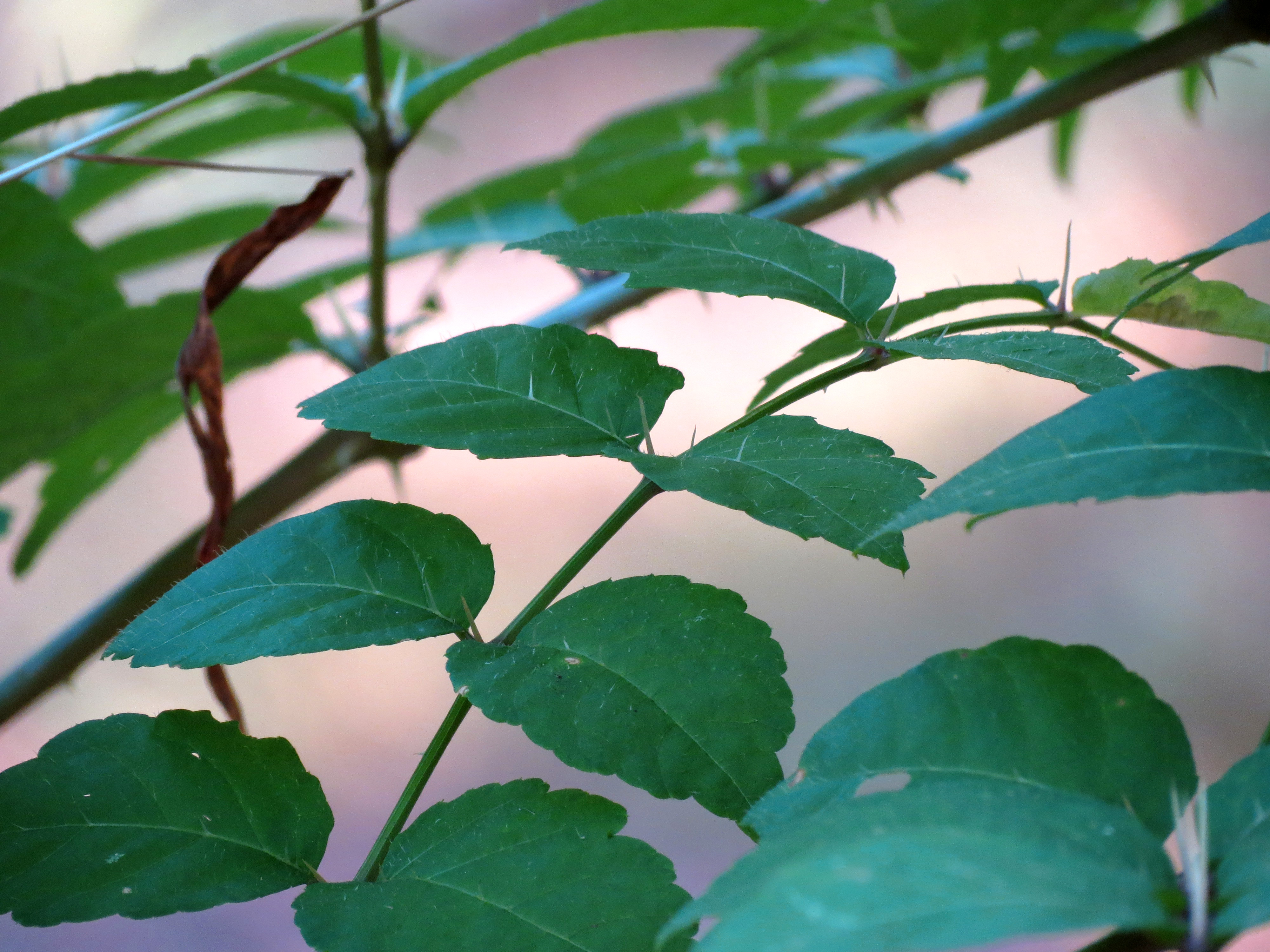
A close-up photo of the budding leaves of a devil’s club plant. (image credit: Wikipedia Commons)
The Tlingit
The Tlingit of southeast Alaska call it s'áxt' and recognize the plant for its spiritual and medicinal properties. In 2024, S'áxt' was KTOO’s Tlingit Word of the Week, which included this translation:
“Naakw yís yéi daadunéi yá sʼáxʼt.
People work on devilʼs club to make medicine.”
The Tlingit found many medicinal uses for Devil’s Club. In a 2004 article, NPR described Devil’s Club as “Tlingit aspirin.” The article stated:
“The Tlingit have turned to devil’s club for a list of ailments you wouldn’t wish on an enemy: from coughs and colds to stomach ulcers, tuberculosis and hypoglycemia. Tribe members steep it into teas, mash it into salves, chew, sip and steam it. It’s also used to ward off evil.”
A map showing the locations of Devil’s Club in the United States and Canada. (image credit: U.S. Department of Agriculture)
The Tlingit are not alone. Tribes of the Pacific Northwest—and even areas around the Great Lakes—have names and uses for Devil’s Club. Modern scientific research affirms that Devil’s Club is a relative of the Ginseng plant and possesses similar properties that offer relief. The Indigenous use of Devil’s Club as medicine was rooted in sound science.
Scientific Name
As settlers pushed deeper into Indigenous territory in the 19th century, they encountered Devil’s Club, but they gave it different names.
Perhaps the first name to appear in print was Pannax Horridus in 1846’s Report and Papers on Botany. The word was a combination of Greek (Pannax meaning all curing) and Latin (Horridus meaning horrible). The name embodied both the positive and negative about the plant. It appeared again in 1862 in the Proceedings of the Linnean Society, suggested it had become the adopted name in the scientific community.
But the name evolved to emphasize the plant’s hostile qualities. Sometimes it appeared as Olpopannax Horridus (Olpo- meaning shielded) or Echinopanax Horidens (Echino- meaning prickly). The names served as warnings, but a common folk name would become far more attention getting.
Naturalist John Muir made Fort Wrangel his home during his journeys in Alaska in 1879-1880.
Folk Name
Like many folk sayings, songs, and names, there is no clear indication where it began. It emerged in written print around the 1870s under three variations that continued for decades: Devil’s Walking Stick, Devil’s Walking Cane, and Devil’s Club. The wording was different, but it always began with Devil.
For settlers, Devil’s Club was a villain of the frontier. It blocked the path forward. It provided no food or shelter, and it seemed to serve no purpose other than to spite weary settlers. Its hellish name was a tribute to its punishing effect upon those who pushed in the wilderness.
The first published instance of the name Devil’s Club may from January 4, 1872 in the Victoria Daily Standard, where a surveyor described cutting a trail through “a quantity of Devil’s Club.”
John Muir may have helped to popularize the name “Devil’s Club.” In 1879, the famous naturalist made his first trip to Alaska and made Fort Wrangel his home. He made money writing about Alaska for newspapers, which were popular and widely republished. In a letter written from Fort Wrangel on October 8, 1879, John Muir described his encounter with Devil’s Club:
“Landing almost anywhere to take a walk in these woods you have first to fight your way through a fringe of bushes tediously intertangled—rubus, huckleberry, dogwood, willow, alder, etc., and a strange looking woody plant about six feet high, with limber, rope-like stems and a head of broad leaves spread out horizontally like those of a palm. Both stem and leaves are covered with keen spires, so that it is almost impossible to grasp it anywhere without getting a multitude of thorns in the flesh. This is echinopanax horrida, popularly known as the Devil’s Club, and used by the Indians to thrash witches—the most truly diabolical threshing instrument conceivable.”
Muir’s observation about the use of Devil’s Club against “witches” is repeated in other sources, such as The Customs and Legends of the Thlinget Indians of Alaska (1962) by O.M. Salisbury, who wrote, “The victim was beaten with devil’s club… or he might be thrown bound, on a bed of thorns or devil’s club…”
(image credit: Wikipedia Commons)

The January 24, 1894 Indiana State Sentinel featured a travelogue by Alta Baker, who described a firsthand encounter:
“One day when I became too anxious to reach a bush of berries I lost my balance, and beginning to fall caught at what I thought was a vine near me; but I was sorry I did so, for it proved to be a devil’s walking cane, and if there is anything that can compare with a porcupine it certainly is this same devil’s walking cane, for it is covered with stickers.”
The December 1, 1896 San Francisco Chronicle interviewed a miner who fell into a pit of Devil’s Club in Alaska which riddled his body with thorns, causing his eyes to swell shut. He said:
“I have carried this face and these hands about with me since the evening of September 2nd last. What that statement means is only to be realized by those who have lived in Alaska and been unlucky enough to encounter devil’s club, and have even but one of the poisonous thorns of the creeper enter the flesh.”
In the August 3, 1932 Kansas City Star, film legend Clark Gable described a boyhood encounter with the prickly plant during a hike in Oregon:
“They’ve got a vine up there called ‘devil’s walking cane.’ Its little thorns dig into your hands and stay there. Once they had to send for a doctor to take care of me, and I spent the whole nine weeks with my hands bandaged.”
For decades to come, the three variations of the Devil’s name—Club, Cane, or Walking Stick—appeared in print. With the advent of mass publication, it appears that the name Devil’s Club became the most popular. Of all the variations, this is likely the most ominous. A cane or walking stick can help you, but a club always hurts. Just the Latin-Greek root, the name is a warning.
The Other “Devil’s Club”
In fact, Devil’s Club is not the first plant to be called Devil’s Club. There is another plant that grows in eastern areas of the United States and Canada also known as Devil’s Club — and even sometimes Devil’s Walking Cane! The November 16, 1824 Pennsylvania Republican described it:
“There is a tree vulgarly called the Devil’s club. Its polite, and I believe dendrological name is Angelica or Angelica Sylvestis. Its fruit, or rather little seeds, when dry, are very good to eat; and the tincture of Angelica is a pleasant and reviving drink.”
While this plant shares a name with the Devil’s Club, the connection ends there. They are biologically two distinct plants.
Devil in the Details
Back to the original question, does Devil’s Club have any connection to Devil’s Thumb?
The answer is no, but that doesn’t mean the comparisons stop there. As settlers pushed deeper into Indigenous territory, they brought a new set of names for plants, places, and peoples. These names provide a glimpse into the newcomers’ perspective. Using “Devil” in the name suggested something dangerous. Just as Devil’s Thumb is a sharp, treacherous peak, so too is Devil’s Club a sharp, dangerous plant.
Whoever first came up with the name “Devil’s Club” is a mystery, but we know that U.S. Navy commander Richard Meade named Devil’s Thumb during a voyage in 1869. Since then, the name has taken on a life of its own. Published in 1953, The Strangest Story Ever Told by Harry Colp sets supernatural events in the area of “the Devil’s Country.” There may not be a connection between Devil’s Club and Devil’s Thumb, but both are examples of the way names shape our impression of nature.